
Going through a break-up is hard. Going through a break-up while still having to drag yourself into work, pretend you’re fine and somehow perform at your best? A complete fucking nightmare.
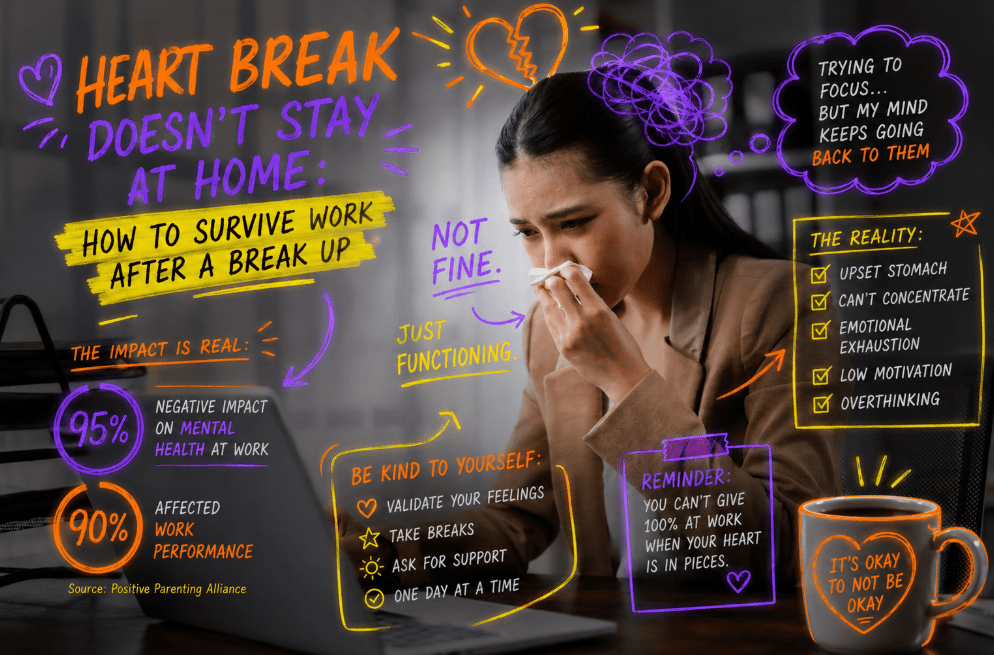
A survey by the Positive Parenting Alliance found that 90% of respondents said separation or divorce affected their work performance, while 95% said it had a negative impact on their mental health at work.
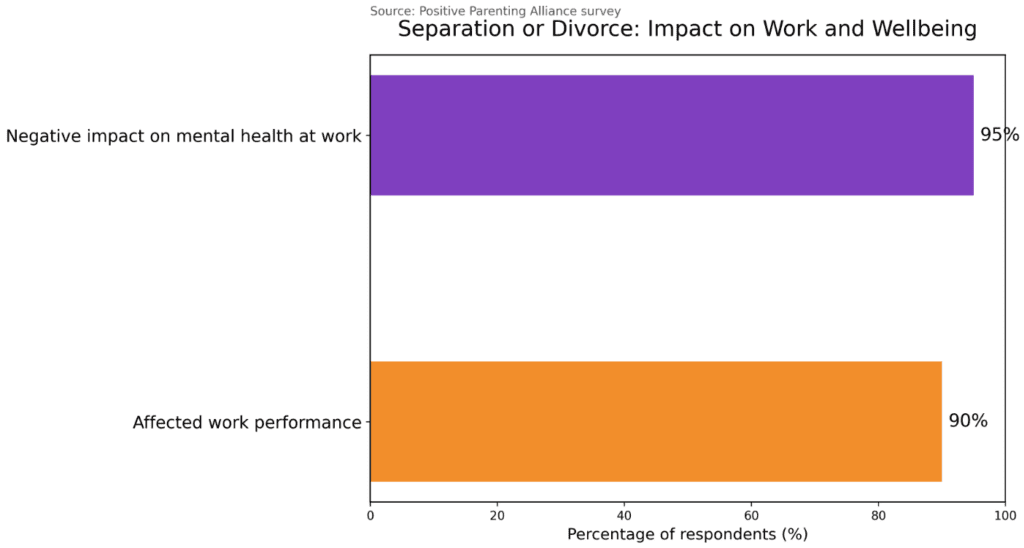
Those figures might sound dramatic, but when you look at what heartbreak actually does to the brain and body, they’re hardly surprising.
Vanessa White is a certified Relationship and Divorce coach, she says: “Breakups affect sleep, stress, emotional regulation, self-esteem, sense of safety.
“So inevitably, anything that affects those kinds of things is going to influence our workplace functioning and the expectation that people can completely separate personal and professional life is something that we really need to change in work culture.”
Whether it’s a divorce after ten years of marriage or a three-month situationship that somehow felt way too intense. Whether you were the one who got dumped or the one who ended it, losing someone who mattered to you is messy, and it can flip your whole world upside down in ways you never expected.
“The question isn’t about whether breakups affect us at work. They do. The question is really, why are we still pretending that they don’t?” White says.
Because heartbreak doesn’t just come with the physical symptoms: the upset stomach, the chest pain, the feeling that your heart has genuinely been ripped out of your chest. Nor is it just the emotional fallout.
The psychological and hormonal effects can undermine the very professional qualities you’ve spent years working your arse off to develop.
Natalia Juarez, a breakup and relationship coach and founder of Lovistics says: “Cortisol, the stress hormone, spikes during heartbreak, degrading the executive functions we rely on most professionally.
“This impacts our decision-making, concentration, and the ability to think clearly under pressure. Your brain is in a state of biochemical recalibration, and that process will always take priority over a nine o’clock meeting.”
It’s no wonder it spills into our working lives. Yet, for some reason, there’s still an expectation that we should brush it off and crack on as if nothing’s happened.

White says: “A big thing about relationships ending is it is a form of grief. Society tends to keep the word grief associated with bereavement. But our brains and our bodies respond in a very similar way through a breakup.
“And we’re not only grieving that person. We’re grieving the future we imagined, the source of our emotional security and often our identity. So it is a massive kind of cognitive load. Our whole future as we thought we had laid out has been essentially wiped off the table.”
But despite this, many workplaces still don’t take heartbreak seriously. Most have policies for bereavement and sickness, yet break-ups, which can trigger stress and emotional turmoil in remarkably similar ways, are often dismissed as just part of life.
When our workplaces minimise heartbreak, we often do the same to ourselves. We convince ourselves we’re overreacting, feel ashamed for struggling and try to power through instead of acknowledging that losing a significant relationship is a genuine life altering event.
White says: “Shame is an emotion that comes up so much with breakups. Often breakups are seen as quite private and temporary and it’s expected that you’re going to move through it super quickly, like it’s not a legitimate wellbeing concern, where of course it is.
“I actually think the younger you are the more those feelings come. I see younger clients and it’s almost like people think that relationships don’t really matter because you’re only say 21.
“And this actually increases shame. They think ‘I shouldn’t be feeling the way I am. Why am I feeling so upset?’ And then we go into a spiral of: ‘God, I must be so weak. I must be such an awful person. No one wants to listen to me.’ And we then internalize it.”
Sounds logical, right? But unfortunately, heartbreak doesn’t give a shit about logic. It turns even the most level-headed people into overthinking, emotionally frazzled versions of themselves.
The good news? There are ways to manage it, so it has less of a grip on your work and a little less power over your day to day life.
One of the first steps is validating your own experience. Stop treating your heartbreak like an inconvenience and let yourself actually go through it. The sooner you stop fighting the feelings, the sooner you can start reconnecting with yourself.
“That’s the starting point. From there, you can better understand your own unique needs and actual capacity. You don’t have to justify your heartbreak to anyone else,” Juarez says.
“This isn’t about suppression or emotionally bypassing your heartbreak by saying, ‘I’m totally fine.’ It’s about containment, acknowledging to yourself that this is happening, and restructuring your life in a way that allows you to keep functioning while also making space for my heartbreak.”
Juarez also recommends some more practical psychological tools that are surprisingly simple.

She says: “One tool is affect labeling, which simply means naming what you’re feeling. Instead of spiraling into ‘What’s wrong with me?’ you might say, ‘I’m feeling sad,’ or ‘I’m feeling rejection’. That small act of naming can create a little space between you and the emotion.
“You can also access this somatically, pausing to notice where you feel the emotion in your body. Many people will notice a tightness in the chest, a weight in the stomach, a tension in the back. Breathing into it and naming it out loud to yourself, rather than pushing through it, tends to interrupt the cycle more effectively than white-knuckling your way to the next task.
She also recommends shorter work cycles. Think Pomodoro-style: 25-30 minutes of focused work, then step away. Stretch your legs, get some air, make yourself a cup of tea.
“This connects to something I emphasize a lot, heartbreak depletes executive function, which is the same source as willpower. So instead of muscling through, which I see a lot, especially with high-functioning, driven people, the smarter move is to structure your environment so that willpower is needed less.
“That might look like having a consistent daily plan to avoid decision fatigue, prepping your meals, or batching similar tasks so your brain isn’t constantly context-switching.”
And that principle doesn’t stop when you log off.
If heartbreak is chewing through your mental bandwidth all day, you can’t afford to treat your time outside work as an afterthought.
“I often tell my clients to think of themselves like high-performance athletes, your off-hours aren’t passive time, they’re active recovery, and they need to be treated intentionally,” Juarez says.
“That means building in grief work, externally through therapy, coaching, or trusted friends, and internally through journaling or creative expression.”
And when all else fails, take the hint. Call in sick. Work from home. Take a day off if you can. Cancel the meeting that really could have been an email. Sometimes the most productive thing you can do is admit you’re not at your best.
White says: “You can’t give 100% of your attention to a spreadsheet or to a meeting if 70% of your brain is trying to make sense of your breakup and is devastated.
“So I think if you are really struggling and in the early days, it is okay to say, actually, I need to just take a few days, get myself together, spend those days crying on my bathroom floor, talking to my mate, actually trying to just get my head around this.
“We want to feel those emotions. If you are feeling really sad, you want an opportunity to let that out because it’s the only way you can actually process it.”
The reality is that heartbreak doesn’t stop the moment you open your laptop. And unfortunately, it’s not going to vanish overnight either.
Maybe it’s time we stopped treating heartbreak like a personal failure to get over and started recognising it for what it is: a genuine life event that deserves a little more compassion, from our workplaces and from ourselves.