

Gÿorgi Bluteau couldn’t remember a time her mother sat still.
Not at weekends or on holiday, not even, she’s sure, in sleep.
There was always something else to be ticked off the ever-growing list; another load of washing, a work call, a dish that had to be fucking put away.
In her childhood home, burning eyes and tight shoulders were the baseline.
And rest? It was something you earned.
At 30, Gÿorgi had her own flat, routine, and life.
And she couldn’t sit still either.
“Both my parents were high-achieving – my mum especially. Growing up, she stayed late at work, and at home, she was always tense, thinking about what had to get done next. Sometimes, she’d walk through the door and start organising paperwork before her coat was even off. We’d joke that she didn’t know how to just do nothing, but there was an underlying sense that relaxing was lazy,” says Györgi, a digital marketing manager based in Rennes, France. “It spilt over into my own life – assignments had to be done the second I received them. I couldn’t wind down, and it got worse when I started working. Being busy felt right; I was physically anxious on days when I didn’t have enough planned, I’d answer emails late at night and had a habit of pushing myself before I’d even been asked to.”
Work stress gets pinned on lots of things: that one manager who’s oblivious to boundaries, asshole co-workers who send you back to your awkward middle school phase.
But exhaustion can predate shitty jobs; sometimes, it’s already there, passed down like bad posture or a fear of confrontation.
“It wasn’t until I began burning out that I started to question where the behaviour was coming from; I realised I’d been operating at low-level stress essentially my entire life,” Gÿorgi says. “And when I looked back at how I grew up, it started making more sense.”


Often, the way we relate to work and rest is shaped by watching our parents.
According to research published in Genes, the effects of chronic stress can persist across generations.
Dr Bonnie Goff is an internationally recognised developmental psychologist and award-winning educator whose research focuses on the neurobiological effects of early adversity.
Based in Los Angeles, California, she’s also a full-time lecturer at UCLA who has dedicated her career to mastering resilience and cycle-breaking.
“We’re born into this world with our reflexes and some rough idea of what it means to be human, but for the most part, our experience is shaped by what we learn. I always think of it as a blank dictionary. What is love? What is work? What is family? We write definitions for all of those things, in ink, not pencil,” she says. “Once it’s written, it’s really hard to rewrite. Many of us have the intellectual understanding – I should rest more – and yet find ourselves incapable of it because of our early childhoods.”
This can manifest in several ways.
“It’s a mixture of behavioural modelling, nervous system mirroring and epigenetics. Behaviourally, when a child grows up watching a parent who is chronically stressed, answering emails at dinner, only relaxing once everything is ‘done’, they adopt those same habits, regardless of what the caregivers actually say. If a mother tells her daughter not to smoke, but has a cigarette in her mouth, the child will model the action over the instruction,” she says. “Physiologically, a child’s nervous system is co-regulated with her caregivers in the first years of her life, so if their nervous system is running on cortisol and vigilance, the child’s developing nervous system mirrors this. When we grow up in a stressful environment, our gene expression actually changes, switching on or off in response to our circumstances. That pattern, which genes are active and which aren’t, is heritable. So, it infiltrates the air that we breathe, in metaphorical but literal ways as well.”
@drbonniegoff #research #genes #epigenetics #dutchhungerwinter #intergenerationaltrauma #maternalgrandmother #mindblowingfacts ♬ original sound – drbonniegoff
It has an annoying tendency to creep into our day-to-day decisions.
“It can look like skipping lunch to work because you’ve always seen your parents do it, or running at 100%, 24 hours a day, seven days a week, since you’ve internalised a version of productivity that is constant and unforgiving – this ends up costing us things like internal regulation or immune function and leads to anxiety, high stress and ultimately burnout.”
This was true for Gÿorgi.
“I was acting in ways I used to resent my mum for. By my late 20’s, I hit a point where I was exhausted all the time, numb, struggling to sleep through the night, and so irritable,” she says. “If I were handed an extra thing to do, I’d panic or burst into tears. I was never relaxed.”
Unfortunately, these patterns are particularly hard to spot given that they mirror those reinforced by our culture.
A woman attempting to unlearn inherited overwork is doing so inside a workplace that punishes anything less than running yourself into the fucking ground.
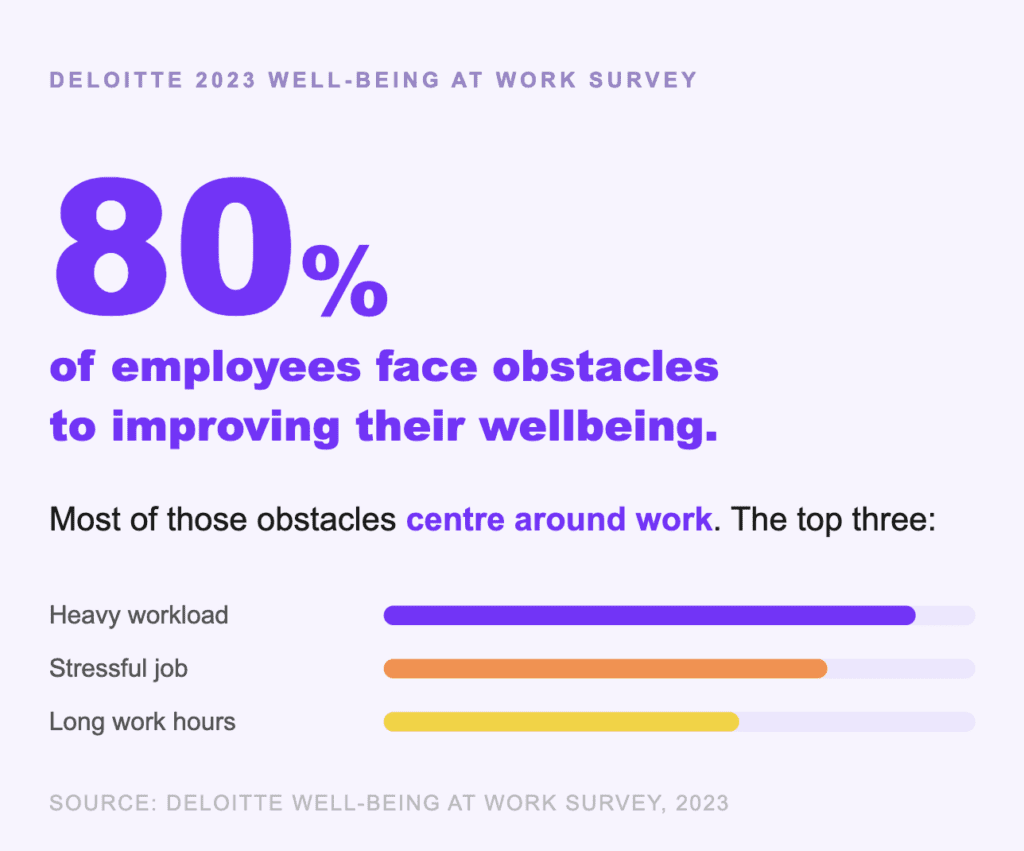
Research by Deloitte finds that most organisations equate overwork with productivity, with executives and managers who clock the longest hours being rewarded the most.
There are ways to identify whether what you’re carrying is yours.
Annie Wright, based in Berkley, California, is a licensed family therapist, trauma-informed psychotherapist, and executive coach, specialising in how early experiences shape adulthood.
She is also the founder and former CEO of Evergreen Counselling, a multimillion-dollar trauma-informed therapy centre, and has appeared in Forbes, Business Insider, Inc., and NBC.
“Inherited work stress is essentially universal among the high-achieving women I work with; almost no one I have ever sat across from in clinical practice arrived at their relationship with work in a vacuum. The ‘I just can’t stop’ story is almost always one you’re given before you had the language to refuse it,” she says. “There are signs that the pattern is older than your job; stopping feels dangerous, not restful. When you finally get a break, instead of relief, you suffer anxiety, agitation, or a low-level depression. That tells you the nervous system has organised itself around productivity as a form of safety. Achievement brings relief, not joy. Hitting a milestone produces a brief exhalation followed almost immediately by the next target. There is no sustained pleasure, no resting on the win. The goalposts always move. No accomplishment feels like enough for long. The bar you set as the ‘destination ‘ turns out to be the new standard the moment you reach it.”
Still, many tend to chalk their fucked-up working patterns up to their personality.
“Women constantly say things like ‘I’m just someone who can’t switch off’ or ‘I tend to be really sensitive’, and it’s one of the most common forms of self-misunderstanding. Personality is who you are. Patterns are how you have learned to survive. Those are very different things, and the distinction matters because patterns can be worked with and retired when they no longer serve you,” she says. “When a woman calls her inherited pattern a personality trait, she is doing two things. First, she is locating the problem inside herself rather than in the family system that shaped her, which feels safer than implicating the people she loves. Second, she is treating the pattern as fixed and identity-level rather than learned and changeable – which feels true because it’s so deeply embedded, but which also forecloses the possibility of healing.”
The good news is that what is learned can be unlearned.
“First, map your inheritance on paper. Write down how the women in your family work, rest, and handle stress. What did you absorb from each of them? You cannot change what you cannot see. Second, Practice micro-stops. Daily, deliberate, ninety-second interruptions of the work trance. Stand up. Look out a window. The pattern you grow up with is reinforced every time you push through, and is loosened every time you don’t,” she says. “Third, audit your calendar and remove one non-essential commitment. Just one. Watch what comes up emotionally when you do – guilt, anxiety. That response is the inheritance speaking; you are now in dialogue with it. Finally, tell one person what you are working on; inherited burnout thrives in isolation, and they’ll interrupt the pattern every time you slide back into it. It isn’t about willpower – it’s about awareness, repetition, and slowly rewiring a nervous system that has been running on an old programme for too long.”
Of course, confronting family patterns is far from easy.
You may crave change, but also feel your heart drop at the mere thought of it – which is entirely valid.

“Looking at inherited patterns means looking at the people who gave them to you. The fear that examining the pattern will require you to place blame on people you love is part of why so many women defer this work for decades. But looking at the pattern is not the same as condemning the people who passed it down,” Wright says. “You can hold two truths at once. You can acknowledge that your mother did the best she could with the tools she had, having been sucked into hustle culture herself, and you can acknowledge that the inheritance she passed down is now costing you your well-being. Both are true. Most who finally do this work find that the only thing more painful than confronting the pattern is the life they were living before they did.”
Now 50, Györgi has spent years unlearning and, through therapy, can finally leave work unfinished without spiralling.

Exhaustion, as it turns out, is a family affair.
Though the habits we pick up in adolescence don’t disappear overnight, that doesn’t mean they never will.
You can choose to break the cycle and, in doing so, pass something healthier on.