


It’s 5:30 pm on a Thursday. Your manager walks over to your desk with a chaotic project that someone else messed up.
“I know you’re completely underwater, but you’re the only person I trust to fix this; you’re so resilient.” They say
On paper, this looks like recognition of your excellence. In reality, it’s an employer weaponising your work ethic.
It’s the ultimate corporate compliment, a trap wrapped in fucking praise and delivered with gratitude, designed to make you feel completely irreplaceable.
But let’s strip away the sodding flattery and call this what it actually is, the ‘competence penalty’
Mainstream wellness will tell you that the resulting panic attack is a sign you need to download a mindfulness app, take some ashwagandha and start setting ‘clearer boundaries’.
Really, it’s less to do with how you cope with an insane workload and more to do with why the shitty system we’re all operating in thinks it’s okay to dump it all on you.
According to Linda Babcock, the average woman spends 200 more hours per year on non-promotable work than her male colleagues.

We’ve always been told that to move up the corporate ladder, it’s down to merit, but what we’re not warned about is that being so ‘compliant’ in your early career can hold you back more than anything.
Organisational psychology reveals that this competence penalty is precisely why being so dedicated has resulted in constant exhaustion rather than the promotion you truly desire.
Let’s break it down.
When your manager is facing a crisis task, they have two options: they can give it to one of their ‘under-performing’ colleagues, which is far too high-risk, or they can give it to someone like you who they know will sacrifice their personal time to execute it quickly and flawlessly.
Basically, they go with the path of least resistance; high-performing women.
Linda Babcok also found that women are disproportionately expected to take on what researchers call ‘non-promotable tasks’, the essential but largely invisible work that keeps organisations ticking over.
The more capable you appear, the more invisible labour gets redirected to you, and over time, you find yourself doing more without actually moving up.
To help you identify when this might be happening, here is a short glossary of corporate gaslighting:
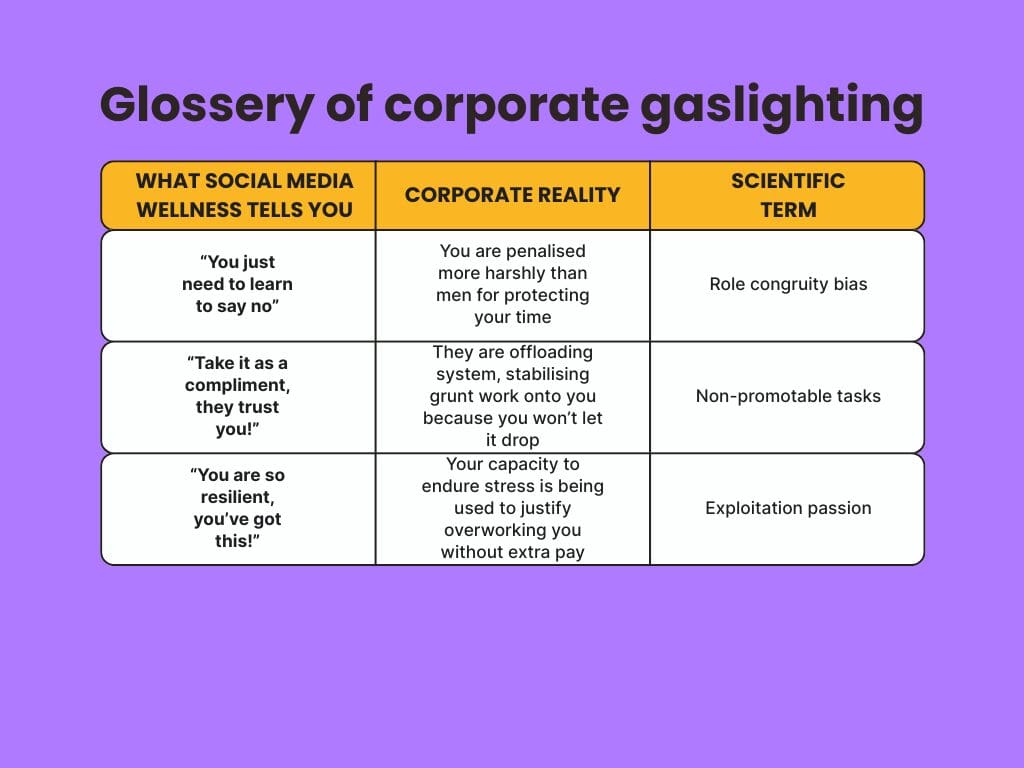
What makes the competence penalty so psychologically effective is that it disguises exploitation as opportunity.
You are not being punished for underperforming, but being overloaded because you are reliable.
This means the behaviours women are programmed to embody in the workplace, say, being emotionally competent, flexible, accommodating or agreeable, are becoming the mechanism through which extra labour is extracted.
To make things worse, this issue appears not to be explicit enough to call out as blatant sexism.
Many workplaces do not reward the person who works hardest; they reward the person whose labour appears more valuable.
And if you’re constantly cleaning up everybody else’s mess behind the scenes, your competence may be sustaining the system more than your own career.
You do not owe an organisation unlimited access to your resilience.