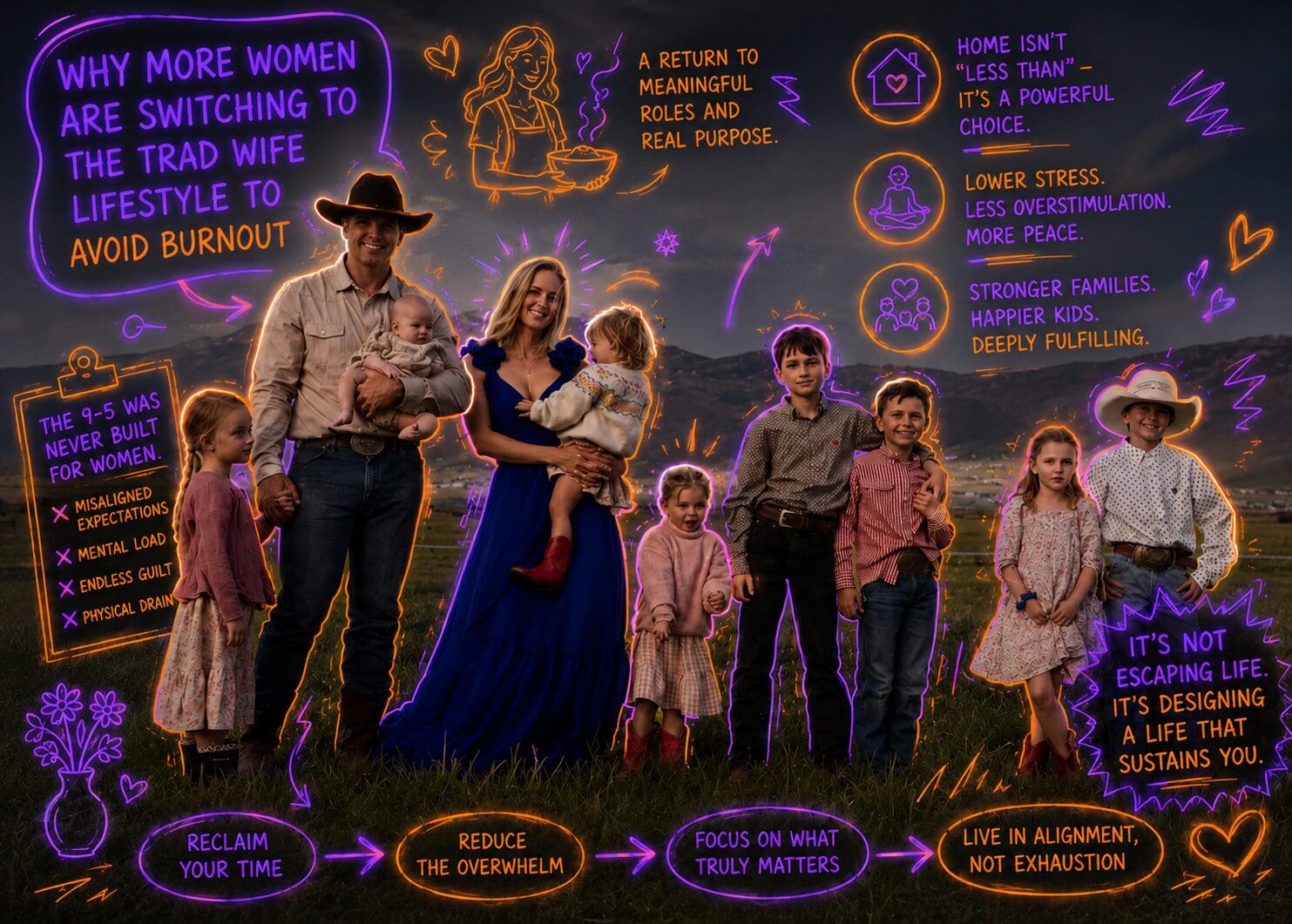

The algorithm knows what you’re watching. One scroll through TikTok or Instagram and you’ll find them: women in linen aprons pulling loaves from the oven, hanging laundry on the line, posting aesthetic shots of homemade preserves. ‘Trad wife’ content has exploded across social media, with hashtags like #tradwife racking up hundreds of millions of views.
Ballerina Farm, Hannah Neeleman’s account documenting her life as a mother of eight on a Utah ranch, has 9.6 million Instagram followers. She’s become the poster child for the movement: beautiful, capable, seemingly fulfilled by a life of domesticity that would have been unremarkable in 1952 but feels radical in 2025.
But here’s what’s actually driving the appeal: it’s the promise of work that doesn’t follow you home, tasks with visible endpoints, and a life where ‘productivity’ means something you can touch rather than an inbox you can never empty.
The trad wife isn’t selling sourdough. She’s selling the dream of an off-switch.
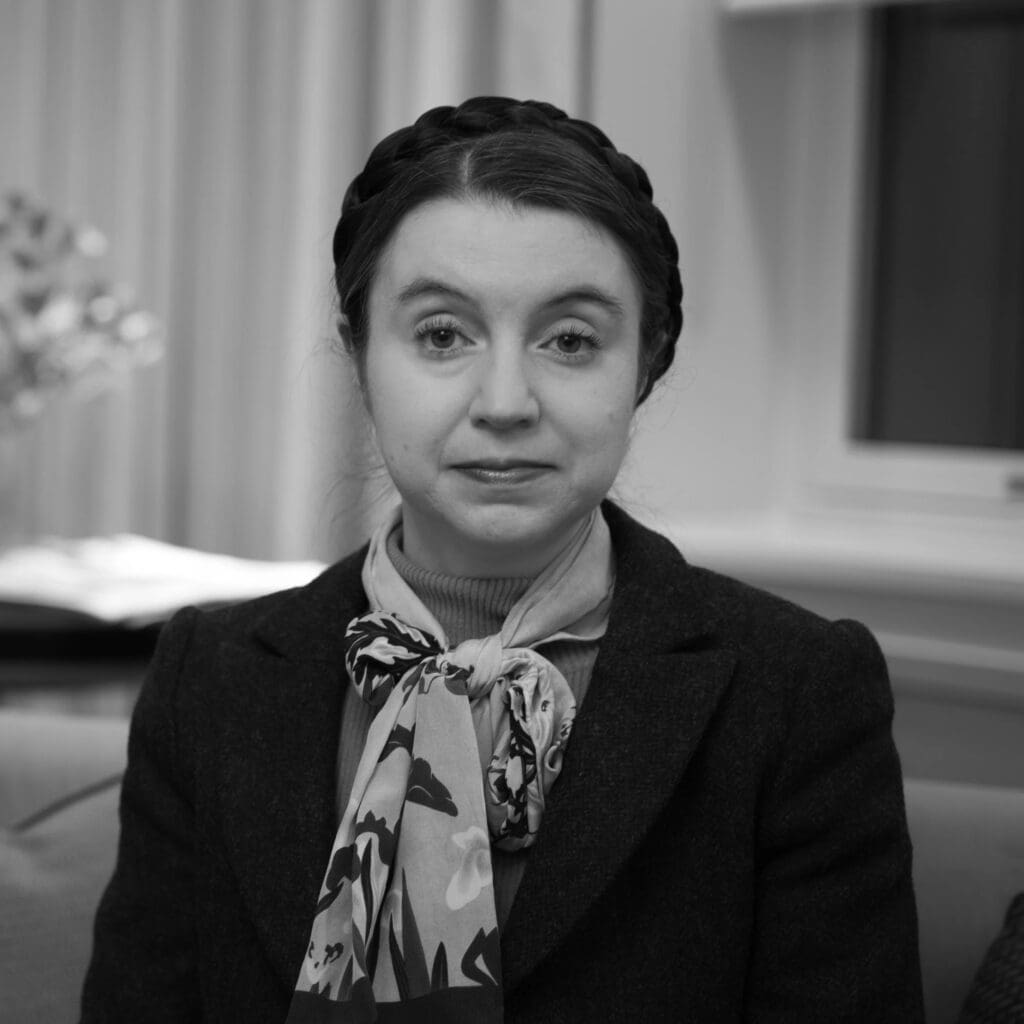
There’s a problem with the entire premise of the movement and Dr. Victoria Bateman, economic historian and author of Economica: A Global History of Women, Wealth & Power wants you to know about.
“The tradwife is not trad,” she says. “For most of history, the majority of women were expected to earn their own money.”
In her research, Bateman points to an 18th-century women’s pamphlet, which warned: “none but a fool will take a wife whose bread must be earned solely by his labour and who will contribute nothing toward it herself.”
Translation: even our great-great-grannies would’ve side-eyed this content.
The image of the dependent housewife isn’t ancient. It’s Victorian. “It was in Victorian times, so relatively recently in the grand scheme of history, that the ‘housewife’ came to be idealised,” Bateman explains. “But, even then, for a lot of families this model of family life failed completely. Reliance on a single breadwinner left families vulnerable, all it took to plummet from comfort to poverty was for a husband to fall ill or lose his job.”
The cost, then as now, was disproportionately borne by women. “Women bore the brunt of any collapse in the standard of living, they were the people who went hungry, as husbands and children had priority at the dinner table. To women today, I say: don’t let that happen to you.”
So no, the trad wife aesthetic isn’t selling history. It’s selling a sanitised version of a relatively short, recent experiment that failed most of the women who lived through it. Cute filter though.
Watch enough trad wife content, and you’ll notice what it never shows: performance reviews. Pointless meetings. The anxiety of an urgent Slack notification. The guilt of leaving at 5 PM. The creeping dread that you’re never quite doing enough.
Instead, it shows tangible labour. Visible accomplishment. Tasks where your effort produces something concrete rather than disappearing into the void of corporate bureaucracy.

Alice Stapleton, a career change coach who works with women considering exactly this, sees the appeal every day. “Often the idea is attractive because of the freedom, flexibility and autonomy it offers,” she explains. “They want their time to be their own, and to not feel controlled by others.”
That’s the real hook. Not feeling controlled by others. The trad wife thing isn’t really about domesticity. It’s about the fantasy of owning your own time again. Which, when you think about it, is fucking damning.
“I’m happier. I am personally feeling more fulfilled while being at home,” says Amy Fitzgerald, 36, who left her career as a dental nurse, to become a stay at home mum. She makes content on TikTok, under the name @amyelizabethhxo, to share her lifetsyle.
“I can look after myself more. Mentally, I’m so much better” she says.
For Amy, the appeal wasn’t ideology. It was relief.
“I often felt, while I was working, that it almost felt like I had to ask permission from my employer to be a mum. Women are expected to work like they don’t have children and mother like they don’t have to go to work.”
Read that twice. Then a third time.
Work like you don’t have children. Mother like you don’t have to go to work.
If you’ve ever felt it, you’ll recognise the particular kind of exhaustion that comes with it. The kind that doesn’t sleep off. The kind that has you scrolling trad wife content at 11 PM whilst still answering work emails. The kind of bullshit that’s been quietly killing women for decades, and we’ve all just learned to call it ‘having it all’.
The movement isn’t monolithic. Two distinct types of women are arriving at the same destination from completely opposite directions.
Type one: the Ideologue
Meet Grace Anderson, who runs the homesteading account Mr and Mrs O, She’s anti-feminist, believes in wifely submission, and thinks traditional gender roles are natural. She’s built a whole brand on it.
“The ‘have it all’ notion pushed by feminism is a fallacy,” Grace says. “You can’t guarantee success in a corporate environment, and even if you could, it will inevitably require sacrifice and be to the detriment of home and family life.”
For Grace, opting out isn’t an escape. It’s a return to what she sees as women’s proper role. “Women are burning out because they are trying to exist in the world as men, and that is not our natural state,” she says. “The grounding antidote is clarity of purpose and leaning into our natural propensities as women every day.”
It’s a coherent worldview, and she’s selling it hard. Whether you agree with her or not, she’s clear about what she believes.
Type two: the Pragmatist
Amy’s story is different. The 36-year-old former dental nurse isn’t making a political statement. She’s solving a logistical crisis. She left because childcare costs were extortionate, her job offered no flexibility, and after her second baby, postpartum OCD made work unmanageable. “I know what it’s like to want to be at home and be with your children, and you can’t,” she says.
Amy explicitly rejects the political framing many trad wife influencers embrace. “Obviously, this kind of lifestyle tends to be seen as conservative and right-wing. But I actually think it’s the opposite.” She points to Sure Start centres, maternity services, and the child benefit cap, all infrastructure that supports mothers, all decimated by Conservative governments. “I think the system is set up to work against mothers. Women in general.”
Two women. Same choice. Completely different reasons. Both deserve respect for the path they’ve chosen. But the outcome? identical: they’ve both left the workforce, and the workforce hasn’t shifted a fucking inch.
Here’s where the aesthetic gets uncomfortable. The TikToks don’t show you the loneliness. The days when nobody talks to an adult. The slow erosion of skills you spent years building.
“It can get lonely and boring if there’s not much to put your energy into,” Stapleton says. “Humans tend to need a sense of purpose and a feeling of self-actualisation. Some may miss being part of a team and community.”
Translation: that linen apron starts looking a lot less aspirational when you’ve spent six months without an actual conversation about anything other than CBeebies.
And then there’s the financial reality. Bateman, as an economic historian, has watched this pattern play out across centuries.
“Being a tradwife isn’t just a privilege, it’s a costly privilege,” she says. “Dropping out of the paid workforce doesn’t just cost you in terms of today’s foregone earnings, the financial consequences snowball with time.”
The maths is grim. While female peers who remain in paid work gain training, promotions, and rising pay, the woman who opts out falls further behind. The gap compounds. The pension pot doesn’t get built. The longer you’re out, the harder it becomes to come back.
“Financial dependency feeds on itself, eating away at your independence and leaving you increasingly vulnerable,” Bateman warns.
She doesn’t mince words on why this matters: “Being financially dependent on someone else, no matter how much you contribute in non-financial ways, lessens your power within a relationship. Money is what talks. That might not be nice to say, but it’s the cold reality of day.”
The trad wife aesthetic sells autonomy. Bateman’s research suggests it can deliver the opposite.
Here’s the uncomfortable truth: whether women are choosing domesticity because they believe it’s their natural role or because work has become genuinely unsustainable, the result is the same. Women disappear from the workforce. And the structures that made staying impossible? They don’t fucking change.
The appeal isn’t irrational. When Mental Health UK’s 2025 Burnout Report finds that only 33% of 18-to-24-year-olds can switch off from work, when workplace ‘flexibility’ means being available at all hours, it starts to make sense why more people starting in the workplace may be swayed into choosing a homestead pathway.
And when childcare costs average £14,000 per year per child, more than most mortgages, choosing to stay home isn’t a weakness. It’s basic fucking maths.
Stapleton doesn’t sugarcoat the workplace failure. “Workloads are just too high. Many people are overworked and burnt out. They can’t see a way out,” she says. “Many workplaces simply don’t offer the flexible working practices that would retain female talent. Too many companies are driven by profit and cost-cutting, not by the experience of their employees.”
Then she drops the line that should haunt every HR department in the country: “Unfortunately, there’s always someone to fill a vacancy, so I’m not convinced it’s a priority for many companies.”
Read that again. The reason workplaces don’t accommodate women isn’t because they can’t. It’s because they don’t have to. The bench is deep. The next woman will burn out too. And the next. And the next. There’s an infinite supply of exhausted women willing to try.
When opting out becomes the normalised solution to systemic dysfunction, the pressure to fix anything evaporates. Employers can keep demanding the impossible because there’s now an Instagrammable exit route for the women who can’t sustain it. Off they go. Productivity intact. Profits up. System untouched.
Bateman, having spent her career studying the rise and fall of civilisations, sees something troubling in the current moment.
“What worries me is that having researched the rise and fall of history’s greatest civilisations, I can see a repeated pattern when it comes to economic collapse,” she says. “Almost without exception, the downfall of civilisation is preceded by a backlash against women’s paid work and the idealisation of the housewife.”
“Let’s not repeat that mistake,” Bateman says.
The current moment, she argues, is critical. “We’re on a knife-edge right now, we can either move forward or backward from here and the future of our economy will rest on the decisions being made by us all.”
That aesthetic Reels content might be cute, but the algorithm might just be radicalising an entire generation back into economic dependency. Fuck.
For any woman seriously considering stepping back from her career, whether for ideology, burnout, or both, Stapleton has one question that cuts through the noise.
“Is it what you want long term?” she asks. “If not, maybe it’s more of a temporary career break you need. Imagine you’re 80 years old. What life would you be proud of? Use your answers to guide your decision and do what’s right for you.”
The 80-year-old test is brutally clarifying. Strip away the aesthetic. Strip away the social media pressure. Strip away the panic of another burnt-out Sunday night.
What do you actually want?
For some women, the honest answer is home. And that’s valid. Genuinely.
For others, the honest answer is: I want my career, but I need it to stop destroying me. That’s also valid, but stepping back won’t fix what’s fundamentally broken about the workplace.
Bateman’s advice cuts even sharper. “Nothing beats having your own cash in your own pocket,” she says. “The only way to have control over your life is to have access to your own money. Don’t let anyone deprive you of that opportunity.”
Look. Nobody’s saying don’t bake bread. Bake all the bread. Grow all the tomatoes. Knit until your hands cramp. There’s nothing wrong with any of it.
What there is something wrong with is a system that’s made “escape into 1952” the most appealing option on offer for educated, capable women in 2026.
Bateman identifies the root issue: “So many of women’s problems right now is the ‘crisis in care’, the lack of reasonable and affordable care options combined with the fact that women are expected to shoulder the burden of unpaid care. Ultimately, we can only share paid work if we also share care.”
Her utopia? “A world in which as many men as women opt to be ‘tradwives’.”
Bring it on, honestly.
That means childcare that doesn’t cost more than you earn. Hours that actually flex. Performance measured by output, not face time. Men taking equal responsibility for the unpaid labour that keeps households running.
Until those changes happen, the trend will keep growing. Because right now, for many women, opting out genuinely looks more sustainable than another year of performing endless availability whilst haemorrhaging money to childcare.
The trad wife aesthetic is selling rest, purpose, and control. And until modern work can offer the same, women will keep watching those videos and wondering if this is societies answer.
The real question isn’t why women find it appealing. The question is: why is this the alternative we’re being offered?