

This is Daisy.
For Daisy, the breaking point didn’t arrive as a dramatic office meltdown. It arrived at 11:47 PM on a Wednesday, when her phone buzzed with yet another work email marked ‘urgent’. She’d been in bed for two hours. And she realised there was no moment in her life where work couldn’t reach her.
At 24, Daisy had everything a young professional is supposed to want. A project manager role coordinating disaster relief across multiple time zones. A résumé so polished it fucking glowed on LinkedIn.
She also had a laptop that lived on her kitchen table, blurring home and office until there was no line at all. A manager who sent requests at 10 PM, expecting morning responses. Slack notifications pinging through dinner, through weekends, through the few hours she’d carved out to see friends.
“I felt that my job was becoming my life,” Daisy says. “There wasn’t a specific moment where I snapped. I just realised I couldn’t keep going like this. I needed to physically remove myself, or I was going to lose myself completely.”
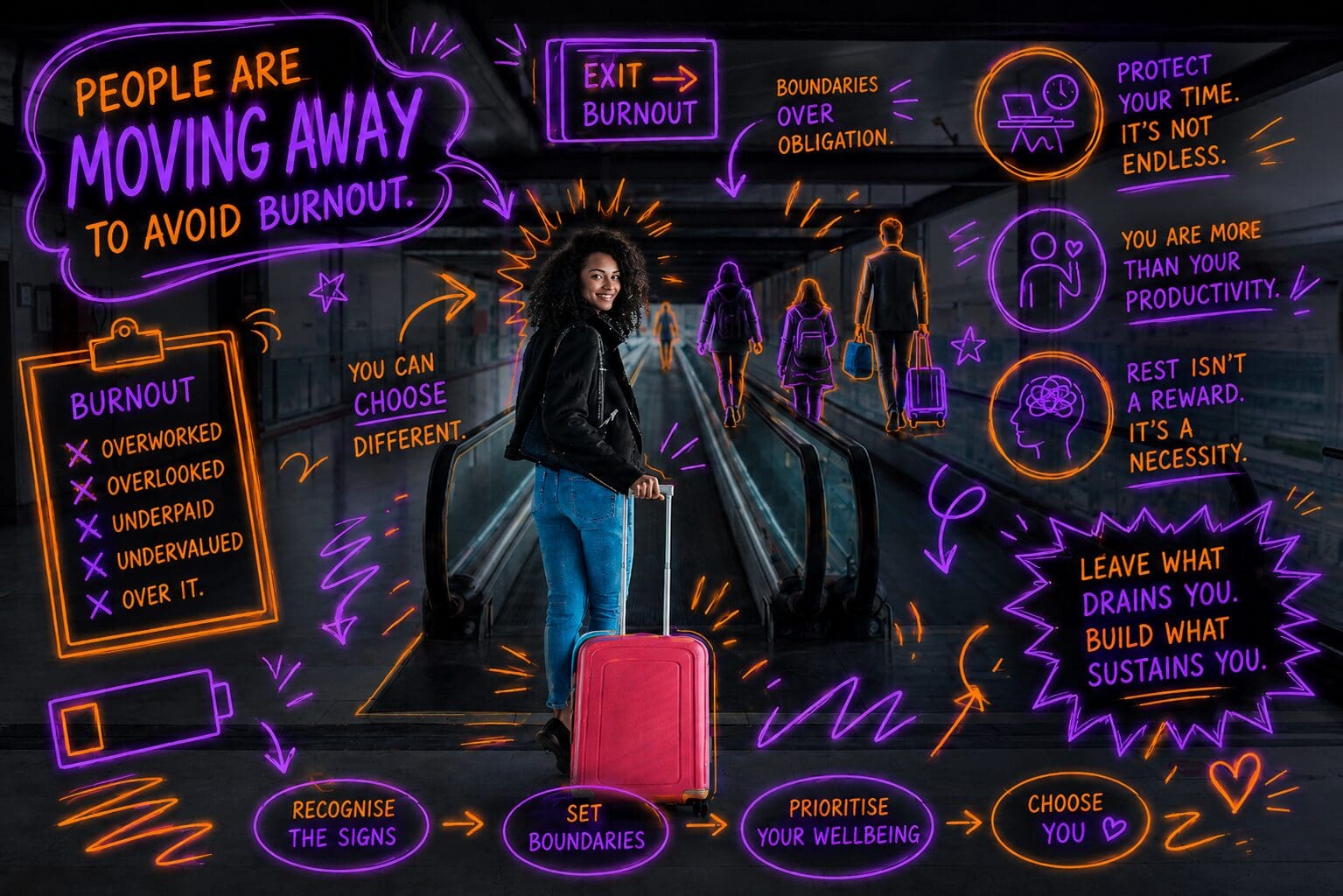
Six weeks later, Daisy boarded a one-way flight. Not a holiday. A psychological evacuation. What addiction recovery circles call a ‘geographical cure’, the belief that physically removing yourself from a toxic environment can break the cycle that is destroying you.
And she’s far from alone.
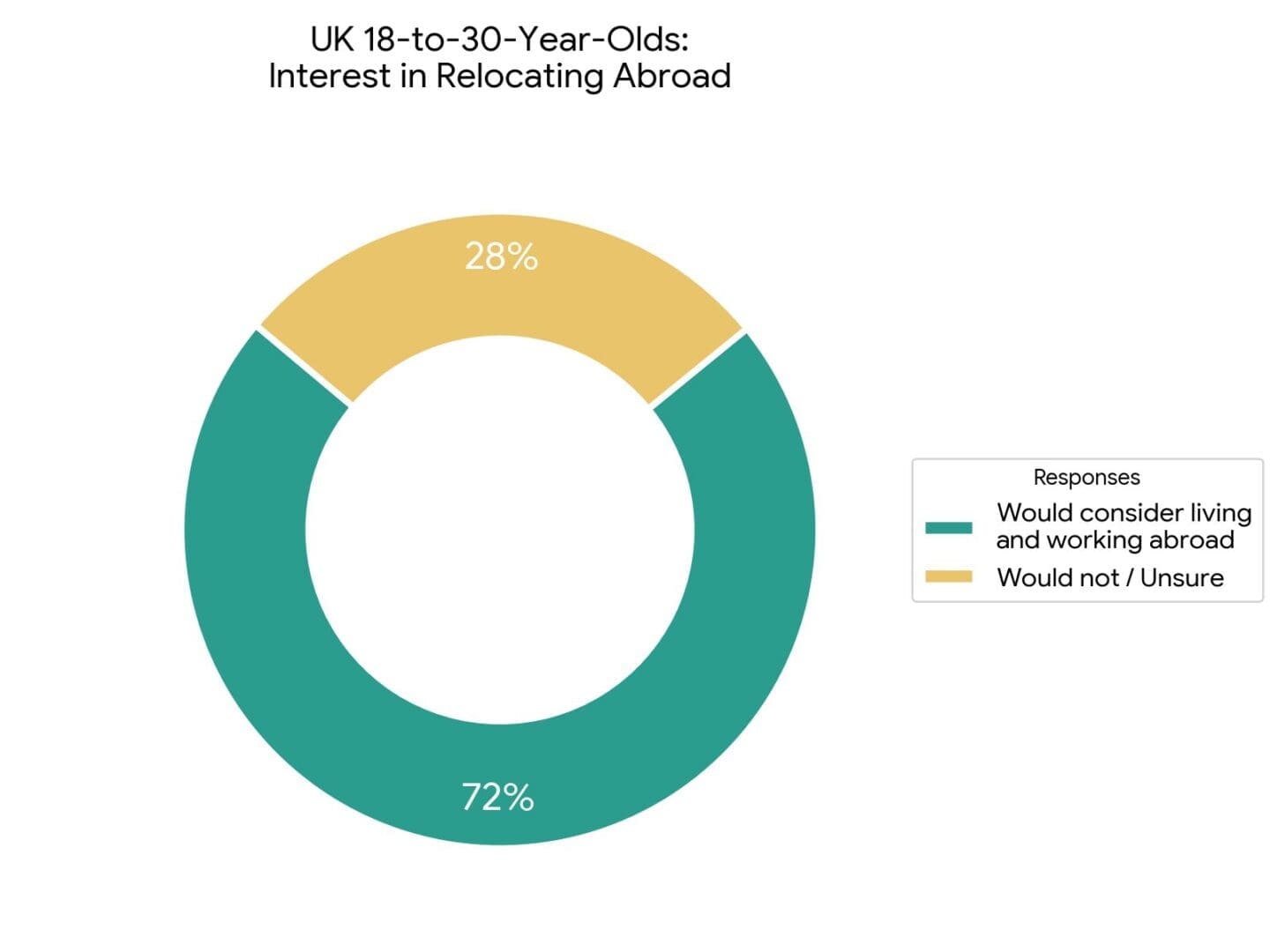
Recent data from the British Council shows 72% of 18 to 30 year olds in the UK would consider living and working abroad.
While the research doesn’t break down motivations, workplace psychologists report a growing trend: young professionals, particularly women, citing burnout as a primary driver.
According to Mental Health UK’s 2025 Burnout Report, only 33% of 18-to-24-year-olds feel they can switch off from work. For young women, that figure drops even lower. One in five adults needed time off last year due to stress, with women significantly overrepresented.
Recognise yourself yet?
Bruce Daisley, former Vice President of Twitter EMEA and author of ‘The Joy of Work’, has spent decades watching corporate culture chew people up.
“Britain has seen wage stagnation for 15 years,” Daisley says. “For most graduates, a starting salary isn’t enough to achieve an independent life. Young professionals fall into a dangerous internal monologue: ‘If I work hard now, I can live a better life later.’ It’s a cycle where urgency is ascribed to everything.”
But women carry a disproportionate burden. We’re fighting wage stagnation and unaffordable housing whilst managing the invisible second shift at home, the emotional labour of keeping everyone functional, and constant pressure to prove we deserve to be in the room.
When the pressure becomes unbearable, workplace culture has an answer: resilience. Daisley is blunt about what that means.
“I wrote a book on resilience being bullshit,” he says. “When your firm wants you to be resilient, they want you to be quiet and suck it up. It’s a way for organisations to transfer responsibility for a toxic environment back onto workers.”

Translation: shut up and deal with it. Resilience is corporate-speak for ‘we know this is breaking you, but that’s your problem, not ours’.
Women, trained from birth to be accommodating and grateful, are especially susceptible. We’re conditioned to believe struggling is a personal failing, not a systemic design flaw. So when the internal monologue becomes unbearable, sometimes the only option that feels within your control is to leave entirely.

Alan Muskett, burnout specialist and author of ‘The Burnout Ladder‘, knows the descent intimately. “The book opens with me waking bolt upright at two AM, heart pounding,” he says. “It was fear. Pure fear of failure driving me to try and be all things to all people.”
His framework identifies six stages:
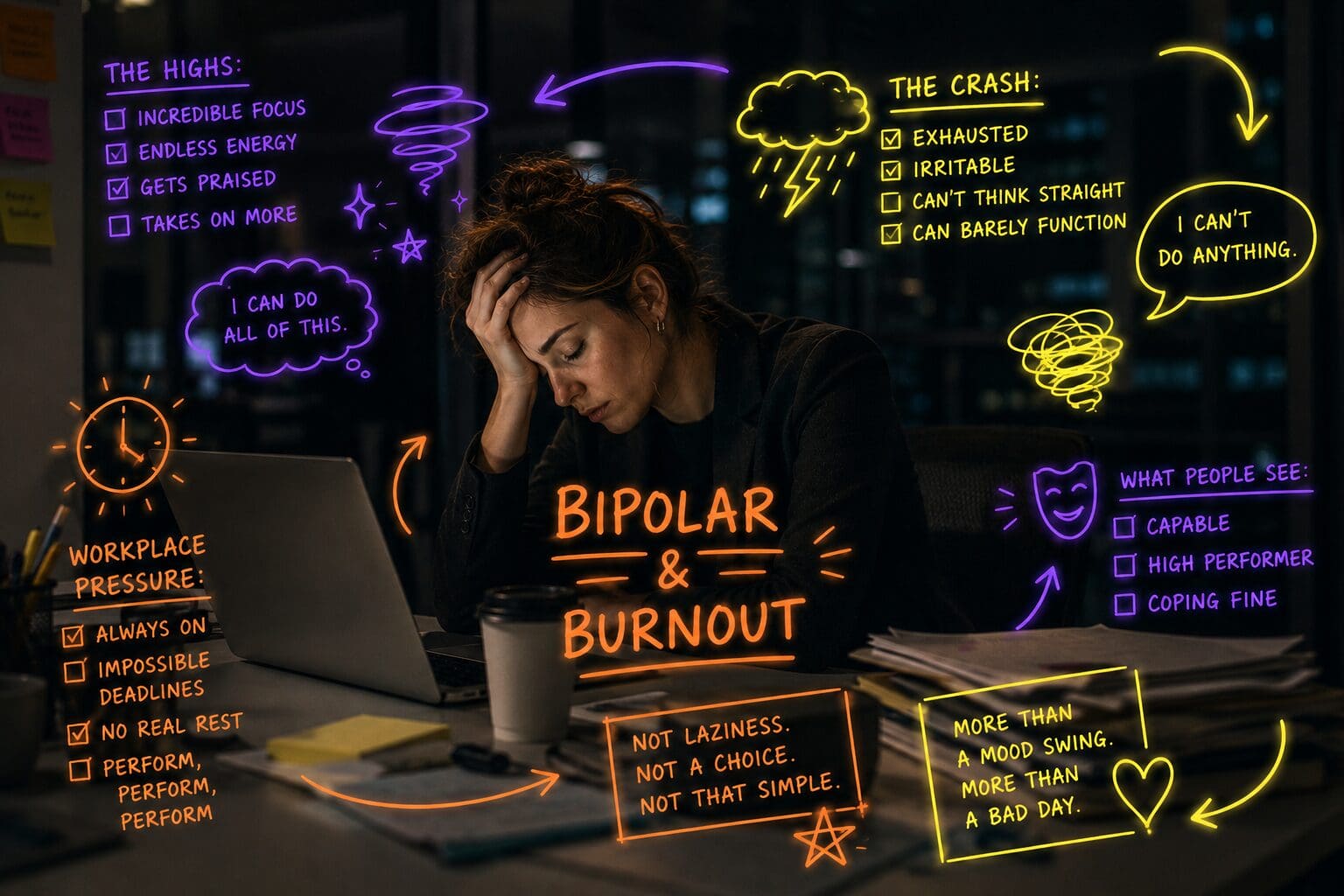
The Honeymoon: You’re energised, crushing it. This is where the addiction to productivity takes hold.
Fuel Shortage: Small cracks appear. You’re tired. Coffee becomes essential. You resent work notifications buzzing outside hours.
Chronic Symptoms: Physical signs emerge. Headaches, disrupted sleep, getting sick more often. You’re irritable with friends and family.
Crisis: You’re making mistakes at work. Missing deadlines. Your performance slips but you’re too exhausted to fix it.
Enmeshment: Work has consumed everything. You can’t remember the last time you did something for enjoyment. Your identity is completely tied to your job.
Embers: The final stage. “It’s what’s left of you when the adrenaline is gone,” Muskett explains. “You can’t get out of bed. You can’t find enjoyment in anything. It’s where burnout meets clinical depression.”
For women, the descent looks different. We don’t just burn out from overwork. We burn out from the constant fucking performance of being okay, from managing everyone else’s emotions whilst suppressing our own, from the exhausting mental arithmetic of being competent without being threatening, ambitious without being pushy.
Daisy recognised herself between Stage Four and Five. “I was making stupid mistakes, things I’d never normally mess up. And I couldn’t switch off. Even when I wasn’t working, I was thinking about work. Worrying. Dreading the next email.”
For Daisy, leaving wasn’t just about escaping the office. Her home had become an extension of it, and her brain couldn’t tell the difference.
Dr. Gail Kinman, an occupational health psychologist, calls this ‘contextual conditioning’. When your brain repeatedly experiences stress in a specific environment, that environment itself becomes a trigger.
“Context matters a great deal,” Dr. Kinman says. “Even the sight of a laptop we use for work can prevent us from relaxing and trigger rumination. There is evidence that merely thinking about opening our email inbox can raise heart rate and blood pressure.”
For women, this compounds. We’re statistically more likely to be doing unpaid domestic labour on top of paid jobs. When work invades that space too, there’s literally nowhere left to recover.

“I couldn’t escape the pings,” Daisy says. “Work Slack, emails coming through at all hours. My manager would send something at 11 PM and I’d see it, then I couldn’t sleep because I was thinking about it. The anxiety was always there.”
Daisley confirms this. “One of the biggest determinants of our wellbeing is a sense of control. The opposite of autonomy is helplessness, and it’s in a state of helplessness that we spiral.”
If helplessness is the feeling, burnout is the destination.
The term ‘geographical cure’ originates from addiction recovery, particularly Alcoholics Anonymous. It refers to the belief that moving locations will solve internal problems. The phrase is usually a warning: you can’t outrun your issues because they’re inside you.
But workplace psychologists find that for burnout, the geographical cure might actually have merit. Turns out, sometimes running away is the healthiest fucking thing you can do.
Dr. Kinman says, “A radical physical exit may provide a useful prompt for people to reassess their priorities.
“But changing your behaviour rather than your location is likely to be more effective long term.”
The risk is avoidant coping. She says, “Without reflecting on your attitudes and behaviours, you risk finding yourself in the same position over time, even if you change location.”
But here’s what experts sometimes miss: for women, those ‘internal patterns’ aren’t just personal quirks. They’re survival mechanisms we’ve been trained into from childhood. The inability to say no. The compulsion to prove ourselves. The fear that if we’re not indispensable, we’re disposable.
You can’t therapise your way out of systemic oppression. Sometimes you need to physically remove yourself from the environment actively fucking you up before you can untangle the internal wiring.
Muskett agrees that physically leaving the toxic environment is often the most effective intervention. But, he says: “You can’t run away from yourself. You can change the scenery, but you have to work on the internal mechanisms that got you onto the ladder in the first place.”
So, should you pack your suitcase? The answer is different for everyone. But both Muskett and Kinman agree: the geographical cure only works if it’s paired with internal work.

The physical move can break the immediate cycle. It can give you breathing room. It can sever the neural pathways that associate your home with chronic stress. But it won’t fix the deeper patterns, the fear of failure, the inability to set boundaries, that got you onto the burnout ladder.
Learning to say no without guilt. Recognising your worth isn’t tied to productivity. Understanding rest is not a reward; it’s a basic requirement for being human. These internal shifts have to happen alongside any external change.
For young women specifically, we’re not just fighting individual burnout. We’re fighting a system designed for men with wives at home managing everything else. The “ideal worker” has no biology, no caring responsibilities, no life outside the office. That worker has never been us.
“I don’t know what the next year holds,” Daisy says. “I don’t know if I’ll come back to the same industry, or even the same country. But I know I couldn’t keep going the way I was. This isn’t running away. It’s choosing myself for the first time in years.”
Maybe that’s the real question: Is it time to pack the suitcase? Or is the real work unpacking the baggage you’ve been carrying all along?
For some of us, it might be both.