
It’s 3 PM. Your brain has left the building. You’re staring at a spreadsheet that’s stopped making sense, willing yourself to focus, and reaching for coffee number four. The internal monologue kicks in: Why am I like this? Why can’t I just push through? Sarah doesn’t seem to need lunch. Maybe I’m just not as disciplined as everyone else.
Here’s what nobody’s telling you: you’re not weak. You’re not lazy. You’re starving.
The 3 PM crash that’s killing your productivity isn’t a character flaw. It’s your body responding entirely rationally to the fact that you’ve been running on caffeine and good intentions for seven hours. And the culture that tells you needing food during the workday is somehow embarrassing? That’s the actual problem.
You’re not imagining the pressure to skip. The average UK lunch break now clocks in at just 33 minutes, a far cry from the traditional hour. According to research from Compass Group, 10% of UK workers take no breaks at all during their working week.
It gets worse. A separate Samsung KX study found 67% of Brits frequently skip their midday meal altogether, with 79% not using their lunch break for themselves at all.
And the kicker: 98% of workers believe lunch breaks would boost their productivity. We know skipping lunch makes us worse at our jobs. We’re doing it anyway.
Rhiannon Lambert, registered nutritionist and founder of the Rhitrition Clinic, sees this pattern constantly. As one of the UK’s leading voices on workplace nutrition and a three-time Sunday Times bestselling author, she’s spent years explaining what should be obvious: bodies need food to function.
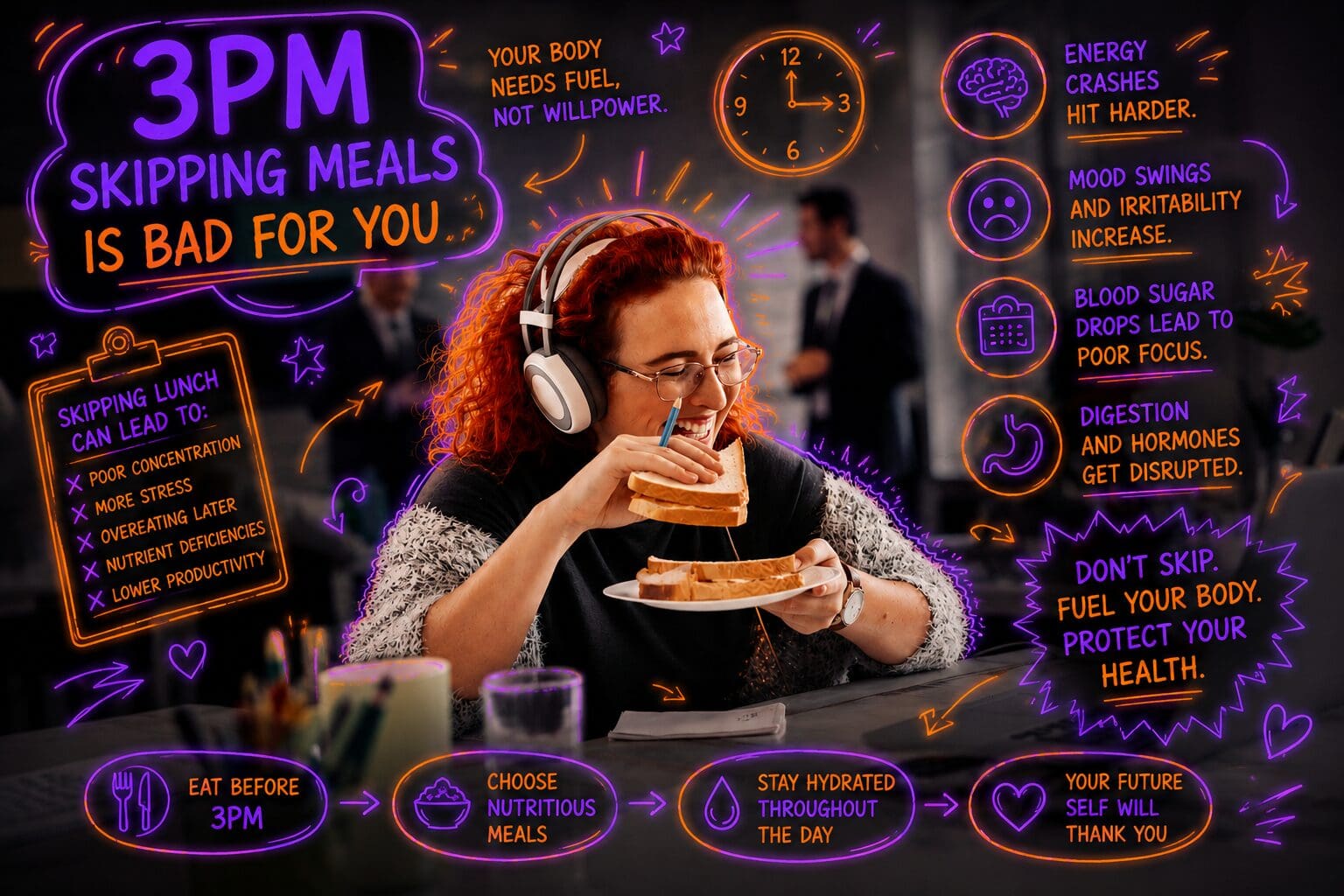
“When we eat breakfast, particularly if it contains carbohydrates, these are broken down into glucose, which enters the bloodstream and becomes one of the body and brain’s key sources of energy,” Lambert says. “If someone has breakfast at 8 AM and then skips lunch, their body will continue using the energy available from that meal throughout the morning. By early afternoon, particularly if breakfast was light or low in protein and fibre, blood glucose may start to dip, and the body has to work harder to maintain energy availability.”
Translation: you’re not crashing because you’re weak. You’re crashing because your body has run out of fucking petrol and is now scraping the bottom of the tank.
“This is when people may notice hunger, reduced concentration, irritability or feeling shaky,” she says. “So, by 3 PM, the ‘crash’ is often not a personal failing, it is the body responding to a genuine lack of fuel.”
Let that sink in. The thing you’ve been blaming yourself for, the thing your manager probably interprets as you ‘checking out’, it’s your body screaming for food.
The 3 PM crash isn’t gender neutral. Whilst Lambert is careful not to overgeneralise, women’s bodies respond differently to the chronic under-fuelling that workplace culture demands.
“Women’s energy needs, appetite, insulin sensitivity and perceived fatigue can fluctuate across the menstrual cycle, particularly in the luteal phase,” she says. “When some women may experience increased hunger, cravings or changes in energy levels.”
So that week before your period, when you’re absolutely ravenous, and colleagues look at you weirdly for eating a proper lunch? That’s biology. Not greediness. Not lack of willpower.
But it gets worse, Lambert says: “Chronically under-fuelling can be more concerning for women because adequate energy availability is important for hormonal health, menstrual function, bone health and overall wellbeing.”
Skipping lunch occasionally isn’t catastrophic. But repeatedly pushing through hunger, “especially alongside stress, exercise and poor sleep, can contribute to low energy availability over time.”
And what is hustle culture if not stress + under-eating + poor sleep, weaponised and repackaged as ambition?
You know coffee’s not lunch. We all know coffee’s not lunch. But somewhere along the way, “I’m just having a coffee” became an acceptable response to “did you eat?” in offices across the country.
Lambert is blunt about why this doesn’t work: “Coffee makes us feel more alert because caffeine blocks adenosine receptors in the brain, which can reduce the feeling of tiredness for a while. But this is very different from providing the body with fuel.”

A meal provides energy, protein, fibre, fats, vitamins and minerals. Coffee does not.
“It can suppress appetite temporarily in some people, which may make it easier to ignore hunger, but the underlying need for food has not disappeared. This can create a cycle where someone pushes through hunger with caffeine, then feels very hungry later in the day, often reaching for quick, high-energy foods because the body is trying to compensate.”
You skip lunch, smash through the afternoon on caffeine, then inhale a meal deal at 5 PM whilst feeling vaguely out of control around food. Then you wake up the next day, do it all over again, and wonder why you feel like absolute shit.
Scroll TikTok long enough, and you’ll find it: women filming their ‘little treats’, an iced oat latte, a £4.50 cookie, a single croissant, framed as self-care. The aesthetic is everywhere. The reality? It’s often replacing actual food.
A 2024 study by ezCater found that 87% of Gen Z employees indulge in a ‘little treat’ at least weekly, the highest among generations. The reasons given? Energy boost (53%), self-reward (42%), and stress relief (38%). And Gen Z workers are four times more likely than Boomers to feel guilty about taking an actual lunch break.
Translation: we’ve been convinced that a £6 matcha is more acceptable than a sandwich.
The wellness industry has rebranded under-eating as empowerment. The £18 Erewhon smoothie. The protein coffee. The mushroom adaptogen latte that ‘fuels your hormones’. Everything is engineered to look like nourishment whilst delivering minimal actual fuel.
“Coffee doesn’t replace those nutrients,” Lambert reminds us. Same goes for the green juice, the matcha, and the bone broth in a coffee cup.
The result? You’re paying premium prices to stay hungry. And calling it self-care.
Here’s the bit that should genuinely scare you: chronic under-eating isn’t just about a bad afternoon. It compounds.
“In women, chronic under-fuelling can affect menstrual function, reproductive hormones, bone health, immune function, mood and recovery from exercise,” Lambert says. “It may also make it harder to meet needs for key nutrients such as iron, calcium, vitamin D, iodine, B vitamins, protein and fibre.”
“I would be cautious about saying skipping lunch alone will ‘damage your metabolism’, as that can become fear-based messaging.” she says.
But the pattern, not the occasional skipped lunch, but the consistent under-fuelling that workplace culture demands, has consequences. Your hormones notice. Your bones notice. Your immune system notices. Your mood absolutely notices.
Here’s the line that should be tattooed on every HR professional’s forehead: “Hunger is not a moral weakness. It is a biological signal”, Lambert says.
“We would not expect a phone to keep working without charge, yet many people expect their bodies and brains to perform for eight or nine hours on coffee and willpower alone.”
Read that again. We plug our phones in obsessively. We charge our laptops at 30%. We treat our electronics with more biological respect than we treat our own fucking bodies. And we’ve somehow convinced ourselves that this is professionalism.
“There is nothing impressive about ignoring our bodies’ basic needs,” Rhiannon says. “Eating enough during the day is not indulgent, it is foundational self-care and, for many people, it can make them better at their work rather than less disciplined.”
Bollocks to the idea that hunger is a sign of dedication. Bollocks to the colleagues who brag about not having time to eat. Bollocks to the manager who schedules meetings through lunch and to the culture that treats women feeding themselves as a luxury rather than the absolute baseline of functioning.
For most women, the answer isn’t a Pinterest-perfect packed lunch. It’s permission.
“Ideally, workplaces should make it normal and acceptable to take a proper lunch break,” Lambert says. “Eating is not an optional extra; it is part of being able to function well.”
But she’s realistic about the constraints women actually face. If you genuinely can’t take a full break, the goal is damage control: “Have something that contains protein, fibre-rich carbohydrates and some fat. Greek yoghurt with fruit and nuts, a wholegrain wrap with hummus and chicken, a boiled egg with oatcakes and fruit, or a smoothie paired with toast and peanut butter.”

The key, she says, “is not to aim for perfection, but to avoid the ‘nothing until 4 PM’ pattern.”
If you’ve been skipping lunch for months or years and want to start eating properly again, don’t try to force it overnight. “Starting with something manageable each day and gradually building from there can help the body readjust to regular nourishment.”
Be patient with yourself. Your body will thank you.
The 3 PM crash is a symptom of a workplace culture that treats the basic biological needs of female bodies as inconvenient distractions from productivity. It’s a system that demands you perform like a machine whilst pretending the machine doesn’t need fuel.
But here’s the radical truth: you are not a productivity machine. You are a human being with a body that requires food, water, rest, and approximately zero apologies for any of it.
The next time 3 PM hits and your brain dies, don’t reach for the fourth coffee. Don’t beat yourself up. Don’t promise yourself you’ll do better tomorrow.
Eat something. Eat enough. Eat without guilt.
The system was never going to feed you. Feed yourself..