
All of us are familiar with the idea of ‘treating’ ourselves after a long day of work.
A JustEat order instead of home cooking, UberX over public transport, maybe a cheeky online shopping spree.
Then there are the less glamorous examples- subscriptions left untouched because cancelling them feels like another task too far, or neglecting your finance admin to avoid the risk of death by boredom.
These isolated decisions can rack up costs at an alarming rate, especially after a particularly shitty week.
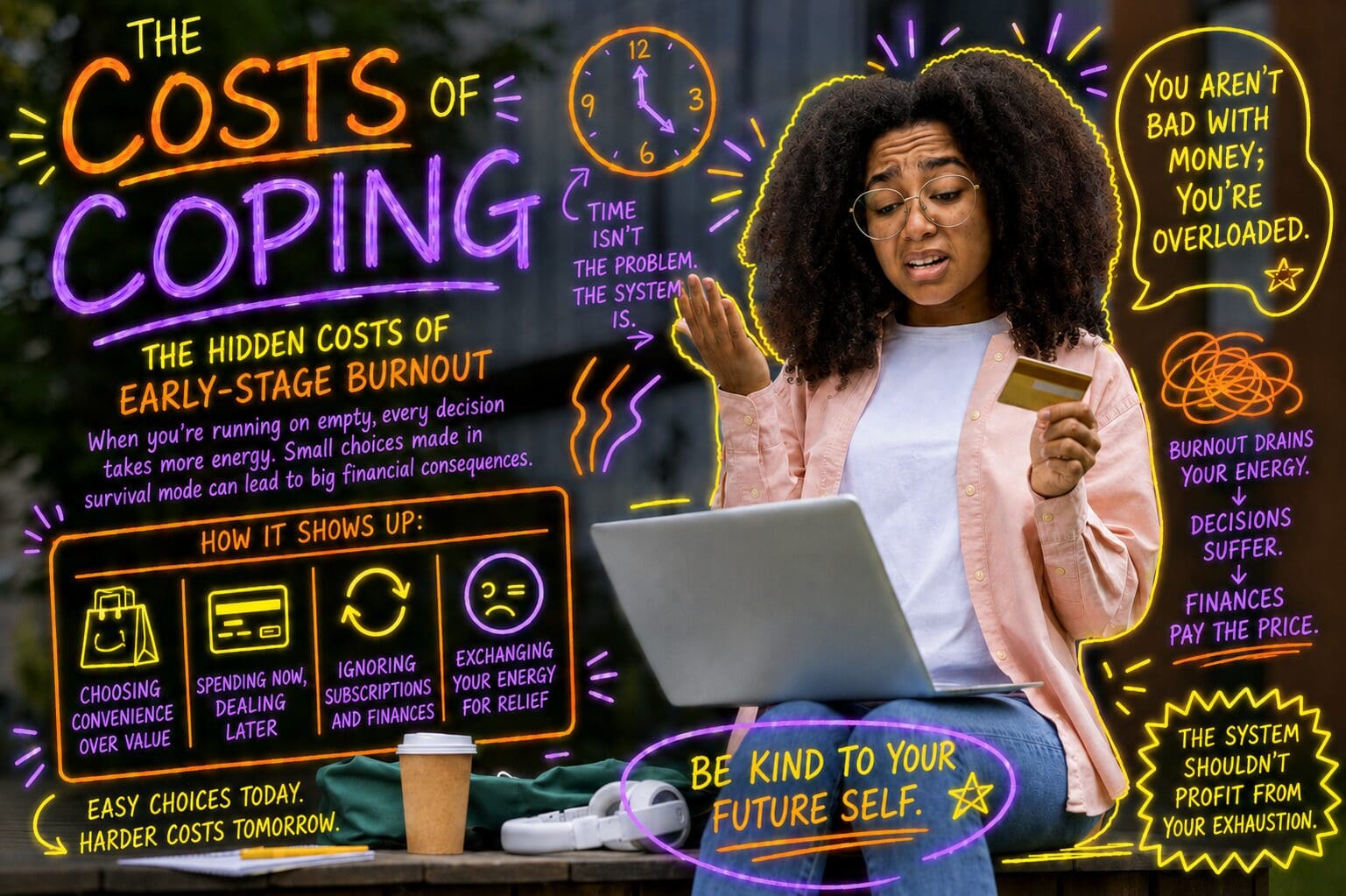
What most don’t realise is that spending habits are symptoms of early-stage burnout: imperceptible behavioural shifts in which reward and relief, convenience and necessity, indulgence and ignorance all start to blur.
The effect of financial choices when people are running on empty and still expected to perform is not just insanely unfair, but unforgiving.
Financial adviser Antonia Medlicott helps people understand how that exhaustion manifests in everyday spending behaviour and warns that it can lead to debt if you’re not careful.
“People are looking basically for the path of least resistance, which can derail long-term financial planning and really put convenience over value for people. It’s a buy now and deal with it later kind of mentality,” she says. “People are probably more likely to enter credit card debt on the back of that time constraint. It all ties into this path of least friction. It’s just people trying to claw back that time. And sadly, that does have an immediate impact on finances.”
Of course, it’s not always easy.
“I spend my entire time trying to teach people how to manage their finances, and even my own can be a little bit scatty,” she says. “From time to time, because I’ve gone through a period where time has been a massive constraint for me.’’
When our spending habits are a direct outcome of our work-related stress, it’s our financial stability that takes the biggest hits.

“Shopping behaviours can also take place as a result of stress, particularly online shopping can serve as a way to decompress. Spend becomes less intentional and more ad hoc to feed the stress beast,” she says. “‘If you go down this road where you’re spending to relieve stress, then some of those hidden costs are going to be things like credit card debt and the interest on that, which can get people into a financially untenable situation.”
When identifying spending issues, Antonia adopts a compassionate approach.
“To call it poor discipline can be really unhelpful because there’s the mental impact, and the relationship between finances and mental health is really tangible,” she says. “There’s always room for compassion, and there’s real room for employers to become more compassionate and to help their employees. Education is the key.”
She says the “hidden costs” are caused not just by spending but also by a failure to take sufficient financial measures.
“People with massive time constraints are much less likely to do things like switch their energy provider, and they have a bank account which has a whole bunch of subscriptions which are floating out which they’re not even aware of,” she says. “You can manage things quite proactively in just a few minutes a day. But it’s about prioritising, and when you’re stressed at work, that priority often gets pushed down the ladder.’’
Separating validated expenditures from irresponsible ones requires a strong emphasis on the individual.
From paying for a luxury holiday to paying a housekeeper, the value varies from person to person.
“These are deeply personal choices. Your time is money, and there’s something to be said for buying back time to spend with your family or at the gym, which can be a source of stress relief,” she says. “There’s a sweet spot in the middle, where you’re not just spending recklessly to try and ease your stress or to claw time back. It needs to be a bit more intentional than that.”
Workplaces tend to forget that we should be operating at, not beyond, capacity.
We’re all fucking fed up with them extorting our time and energy; no wonder people find themselves completely depleted.

Audrey Tang is a psychologist who has researched burnout and emotional labour.
She frames decision-making burnout as a mismatch between what’s being demanded and what someone has left to give.
“The best definition of decision-making burnout is when demand exceeds resources. You have nothing left to give, but people still want more from you. When somebody is under stress or burnt out, they are effectively in pain; they’re in distress. It’s not a happy space to be in,” she says. “When people are in that space, they want to feel better. For some, feeling better may be spending on comfort eating, alcohol, impulse buying, whatever it is that gives you that little dopamine hit that makes you think ‘Ok, now I can cope’. All we’re trying to do is survive.”
The shitty financial consequences of coping often go unnoticed until they hold a vice-like grip over your bank account. Still, it’s unfair to judge people’s spending habits harshly.
Audrey insists that the conclusion should not be a moral judgement:
“If we are already spent with our energy, we get to the point where you just can’t make another decision. Burnout affects our decision-making, not because we’re bad people, but it makes us bad decision-makers,” she says. “It just depletes our energy. When we have no more energy, it’s a lot harder to make any sort of sensible choice.”
The psychology of decision-making under pressure and the financial patterns that emerge call into question the systems that normalise energy depletion.
Workplaces only pay us what we’ve earned, and tend not to give a shit if we’re too exhausted to spend our pay wisely.
Clare Kenny is a leadership coach and workplace consultant who draws the comparison between energy and credit card debt.
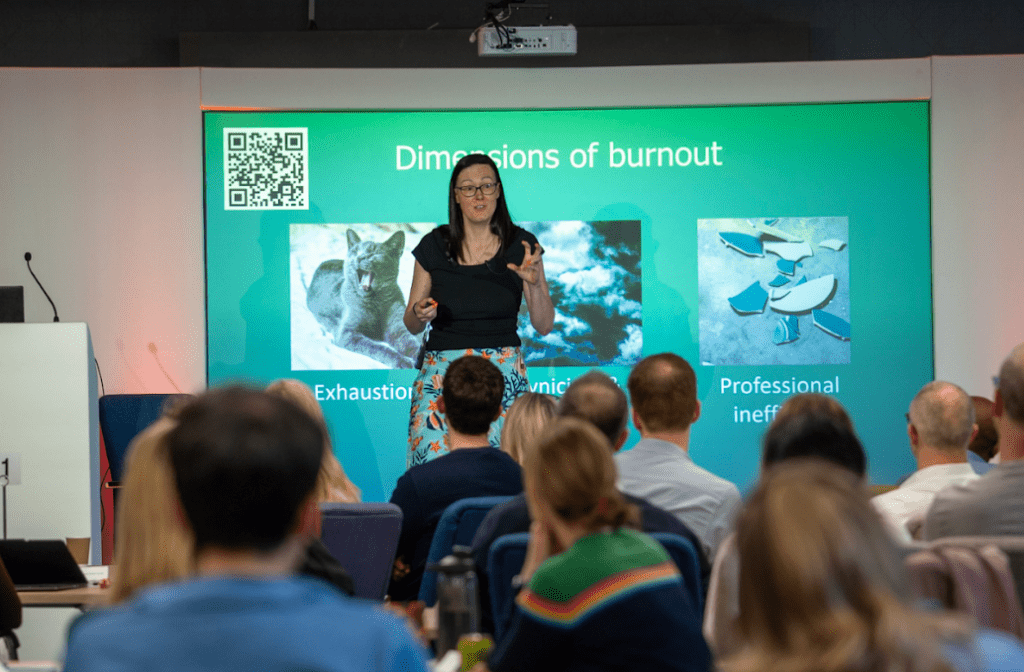
‘’Imagine your energy is currency, and when you begin to burn out, you’re spending on your credit card. You are not spending money that you have. You are getting into an energy debt. Your ‘payments’ may seem fairly low until suddenly you’ve got tons and tons of debt and you’re unable to pay it off- that’s when you’re beginning to burn out,” she says. “What tends to happen in workplaces is that people keep pushing through, even when they’re exhausted, because that’s what’s expected of them. We focus on productivity and performance without really stopping to ask what it’s costing people to keep delivering at that level.’’
Choosing productivity over personal welfare is something we’ve become far too accustomed to; it really shouldn’t be, given all that pressure we feel goes untreated and unaddressed by our employers.
“Employees don’t necessarily realise they’re struggling, because the environment around them treats that level of pressure as normal. Whilst the individual continues to deliver, the wider system rarely accounts for the cost,” she says. “It can be difficult to see the full picture. You might see someone turning up and doing their job, but not what that person is spending, sacrificing or compensating with in order to keep showing up.”
Individuals are encouraged to manage themselves within systems that are arguably unsustainable.
Costs can be easy to miss. They don’t arrive all at once. There is no single event, no dramatic financial collapse, no obvious moment where things go wrong.
The cost of functioning while depleted accumulates quietly, absorbed through small conveniences, deferred decisions and coping behaviours that make everyday life manageable in the short term.
The brain is no longer optimising for long-term outcomes; it is, understandably, prioritising immediate relief.
People might not stop caring about consequences, but planning can give way to coping. Psychological shifts in everyday financial behaviour can lead someone who is far from careless with money to prioritise ease wherever possible.
Time scarcity can lead to neglecting long-term financial tasks, even when you know they matter. The credit card metaphor captures what happens next; you operate in a constant state of depletion, beginning to spend energy you don’t even have.
An overdraft can initially go unnoticed. Life goes on, work still gets done, and costs quietly add up in the background.
These behaviours are signs of adaptation, not apathy or excess.
For readers who recognise themselves in these patterns, the verdict is not guilt, nor another 1000-point checklist of better decisions.
Compassion, honesty and scrutiny can help make the difficult decisions in disguise more transparent, and the irrational expenditures less tempting.
As for the ones that truly make you happy, they’re a well-deserved treat.