
Talia Sparks’ heart was hammering so hard she could feel it in her throat.
It was 9 pm, and her office, which had long emptied, seemed to be tormenting her with the hum of its faulty air conditioner.
It didn’t help that her head was throbbing like it might explode – which would be wildly fucking inconvenient given the meeting she had tomorrow morning.
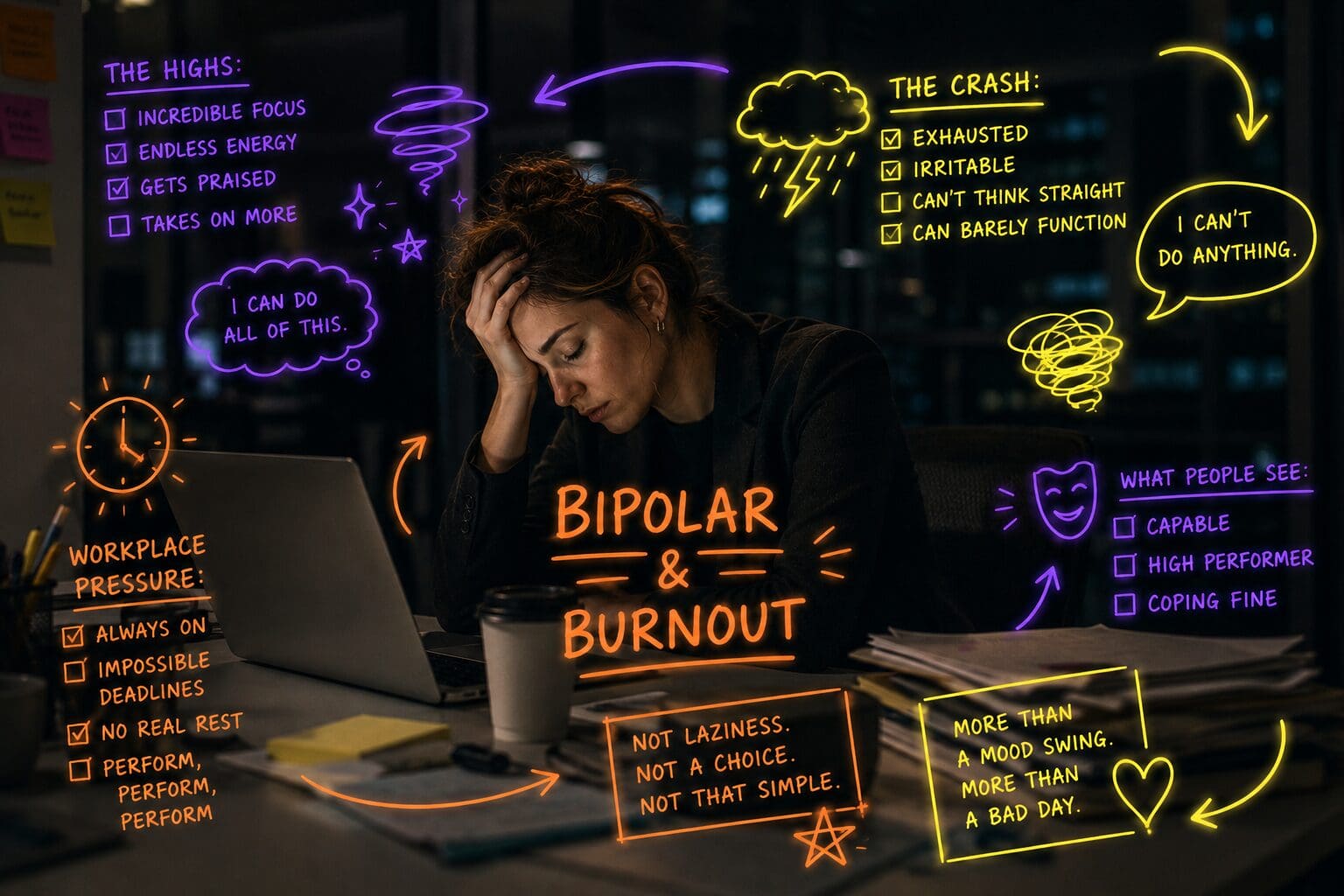
Talia, however, didn’t see the tense shoulders or twitching eye as warning signs, but as proof of her professional capacity.
She was ‘in the zone’ – and according to her internal monologue, the blueprint of resilience.
It seemed like strength.
The keyword being ‘seemed’.
Based in Sydney, Talia started working as a corporate dietitian in 2024.


“I’ve realised at certain points that I needed to take a break, but kept pushing, thinking it meant I was hardworking. Last month, I was performing at 120-140% of my KPIs and continued to schedule customers, regardless of how full I could see my books were or how overwhelmed I felt,” she says. “At my peak performance, ironically, my peak burnout, I’d be working late, and experience stress attacks where my breathing would constrict, or I’d have a million thoughts a minute.”
Resilience is what gets us through long meetings or conversations with co-workers who insist on wishing us a cheery ‘happy Monday’ before 9 am.
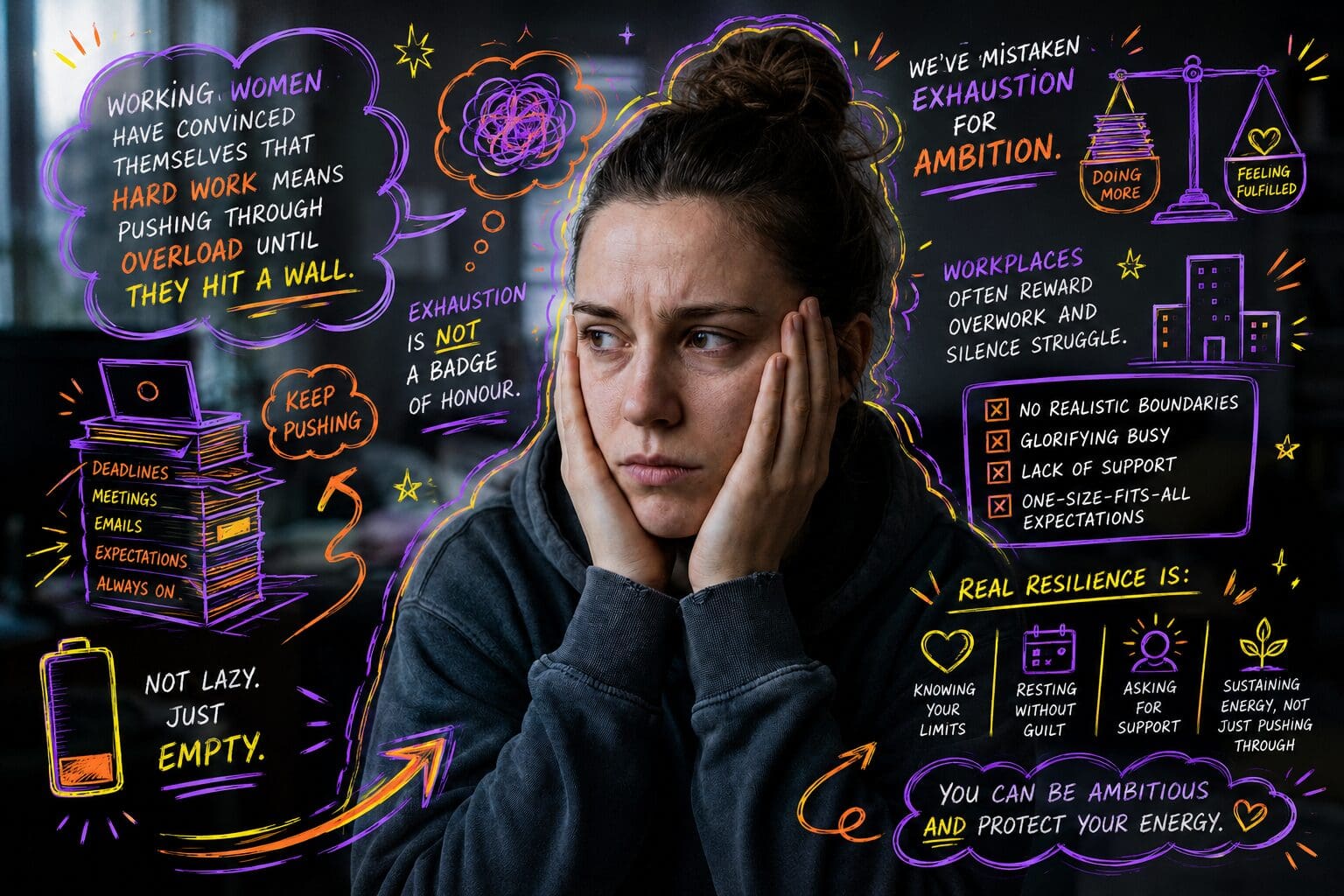
Somehow, we’ve internalised a version where endurance equals strength, thinking the more we can stomach, the more resilient and therefore capable we are.
“I thrive on being perceived as successful and high-functioning,” Talia says. “It’s to my detriment, I struggle to stop or ask for help; it feels like failure.”
While it’s an easy trap to fall into, a 2016 Hallmark study found that burnout isn’t a symptom of weakness, but a natural result of prolonged stress without the resources to recover.
Though we’re the ones practising toxic resilience, we’re doing so in environments that have a pretty clear interest in keeping us exactly where we are.

Named Best Workplace Stress and Resilience Coach 2025 by UK Enterprise, Cambridge-based Kelly Swingler is the author of F*ck Burnout: Why We Need to Call BS on Workplace Wellbeing, and a TEDx speaker.
Also a former HR director, she spent two decades with a front‑row seat to how organisations operate and later founded the multi‑award‑winning HR consultancy The Chrysalis Crew.
“Leaders have done an amazing job of telling us that success means constantly going above and beyond. You want the promotion? Hustle harder. You want the pay rise? Go the extra mile,” she says. “What they mean when they ask for resilience is keep going, no matter how hard we push you, how many resources we remove, how little support we give, it’s workplace neglect and abuse.”
As fucked-up as it sounds, organisations don’t need to convince you of much once you’re sold on the idea that it’s what ‘strong women’ do.
“Workplaces repeatedly weaponise resilience. When a woman establishes herself as the one who can handle everything, they benefit from and reinforces that, knowing she’d rather protect that image than speak up,” Swingler says. “Expectations are set, and we don’t want to be seen to be crumbling under them, so we paint on the face, armour up, and keep going.”
Of course, not all workplaces treat burnout as a professional asset.
According to The Times, half of all UK employers report offering resilience training.
Globally, firms like Google, Deloitte, and PwC have launched dedicated well-being initiatives.
But if we’re going to get anywhere, there also has to be internal change.
So, if pushing until you break isn’t resilience. What the hell is?
Dr Claire Plumbly is a clinical psychologist, specialising in burnout and resilience, and the author of Burnout: How to Manage Your Nervous System Before It Manages You.
Based in Somerset, she is also the founder of Plum Psychology and has written for The Telegraph, BBC, and Health & Well-Being.
“Working women have interpreted resilience as taking punch after punch and still standing. It’s confused with chronic endurance, involving persistently overriding basic needs or minimising negative internal experiences. It’s also that ‘comes with the territory’ type of thinking, or the belief that if you can get through this week, it’ll be quiet next week. This lasts only so long before something gives,” she says. “It isn’t about putting on a brave face; it means noticing the pressures and their impact on your capacity, then tending to the arising needs so you can continue functioning.”
There are many reasons we’ve convinced ourselves that the warped definition has merit.
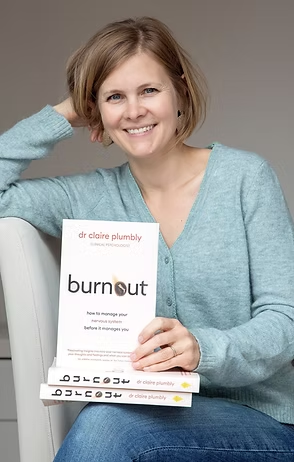
“Many mistake acknowledging strain as admitting defeat; it triggers feelings of inadequacy. Others build their professional identity around being the woman who can cope, not wanting to suggest to others that you’re losing your edge is a very real fear,” she says. “When you override your internal cues for long enough, you become practised at doing so, and don’t feel that you can afford to do anything differently.”
Women are particularly vulnerable to this, according to the Facilities Management Journal, which found that we experience burnout differently and more frequently due to increased emotional exhaustion and perfectionist tendencies.
“Generally, women face more obstacles in the workplace to prove themselves, also taking on emotional labour, which is largely invisible and which men tend not to experience,” she says. “We’re socially conditioned and praised for behaviours that add to false resilience, like being accommodating or doing it all.”
As Dr Plumbly points out, false resilience can manifest in more ways than swallowing insane workloads.
You may be putting up with a lot of bullshit at work, then biting your tongue so hard you can taste it.
We don’t blame you; ‘tolerate dysfunction’ wasn’t in the fucking job description.
DaJung Chung, a senior product and account manager in Singapore, endured a toxic workplace in her first role as a market researcher in Korea.

“My boundaries were regularly crossed, and whenever I offered an opinion or raised a concern, it was swiftly dismissed. I didn’t speak up and told myself I was being professional, composed, and adaptable,” she says. “I understood resilience as continuing no matter what, always being okay, and never rocking the boat. Even when exhaustion sat heavy on my chest, I insisted that if I could make it through the day, it’d get better; it never did. I was being crushed under the weight of my own silence and calling it strength.”
This affected her well-being.
“After months of being drained, my immunity gave out. I developed a UTI and ended up in the emergency room at 4 am. I texted my manager to let her know. Her reply? ‘Hope you feel better, see you in the office at 9 am,’” she says. “By the end, I was hollowed out, depressed, and anxious. Brain fog became my default state, and my inner monologue had turned almost entirely negative. I was completely depleted.”
It didn’t help that her company were handing out proverbial gold stars that rewarded the exhaustion.
“When your colleagues are all pushing through, and your manager expects and praises that resilience,” she says. “You stop questioning it. You internalise it.”
@djvibely Another day in the office! Back to back meetings and watching Nikki Glaser host the Golden Globes during lunch – she’s a good roaster 😆🏆🪩🍝💻 #diml #ditl #dayinmylife #corporatelife #timestamps ♬ original sound – DJC
Whether your relationship with resilience looks like DaJung’s or Talia’s, it’s likely running you into the ground.
“When chronic stress and pushing through are no longer sustainable, it shows up as IBS, migraines, cardiac issues, and eczema. It also prompts nervous system dysregulation, where you always feel on edge or irritable,” Dr Plumbly says. “Some become socially isolated, especially when the strain of constantly persevering gets taken out on those closest to us; when it seems nobody gets it, you stop sharing altogether. It takes a toll.”
Internally, you can learn real resilience, and you don’t have to download another shitty wellness app to do it.
“You don’t need a 10,000-point wellbeing checklist – you need to acknowledge that how you feel is a direct result of what you’re putting yourself through. Start by paying attention to your body. The headaches, upset stomach and breakouts are all signs of an imbalance,” Swingler says. “On a day-to-day basis, at breakfast or before bed, sit with your back upright, feet flat on the ground, and take three breaths in and out to ground yourself, then identify signals, physically note them down, and tackle them before they build up.”
If you feel stuck in a dysfunctional environment, there are ways to cope.
“Set your non-negotiables, what you will and won’t tolerate. To do that, grab a notebook and answer: what gets you out of bed? What pisses you off when it’s missing? Once you have them, communicate them to yourself and to others,” Swingler says. “There will be pushback because people want you to do what they want, not what’s best for you. Once you call something non‑negotiable, you make it clear it isn’t movable. For me, my sleep is not up for discussion. If a client wants an evening meeting, it’s a no. The sooner you do this, the sooner people will accept it.”
And if you’re considering a move or want to have a chat with your manager, you should understand what constitutes a healthy culture.
“Organisations that understand resilience encourage realistic hours, proper holidays, and actual time out,” Swingler says. “There shouldn’t be any rhetoric around disengagement because you protect your evenings, and support is leadership’s responsibility, not a perk.”
As it turns out, what doesn’t kill you doesn’t make you stronger; it just makes you really good at pretending.
If you’ve been succeeding at a version of resilience that asks you to take hit after hit, know the original always included recovery.
DaJung has accepted that burnout isn’t a badge of honour; Talia is working on it, but more actively than ever.
There’s nothing wrong with being driven, as long as you don’t mistake how much you can endure before you crack as proof of it.