
“What’s your first degree in?” Dr Kate Atkin’s fellow master’s students asked.
Her stomach dropped. She felt apprehensive to admit that she pursued a HND (Higher National Diploma) instead of a bachelor’s degree.
“It stands for Has No Degree,” someone responded.
Well shit. In one throwaway comment, years of hard work were reduced to a cheap joke.
“I sort of really had this intense feeling of ‘I shouldn’t be here. What am I doing? I don’t know enough.’ going through my head,” she says. “I applied to do a Masters in my late 40s and I delayed going to university for 12 months because I didn’t think I knew enough.”

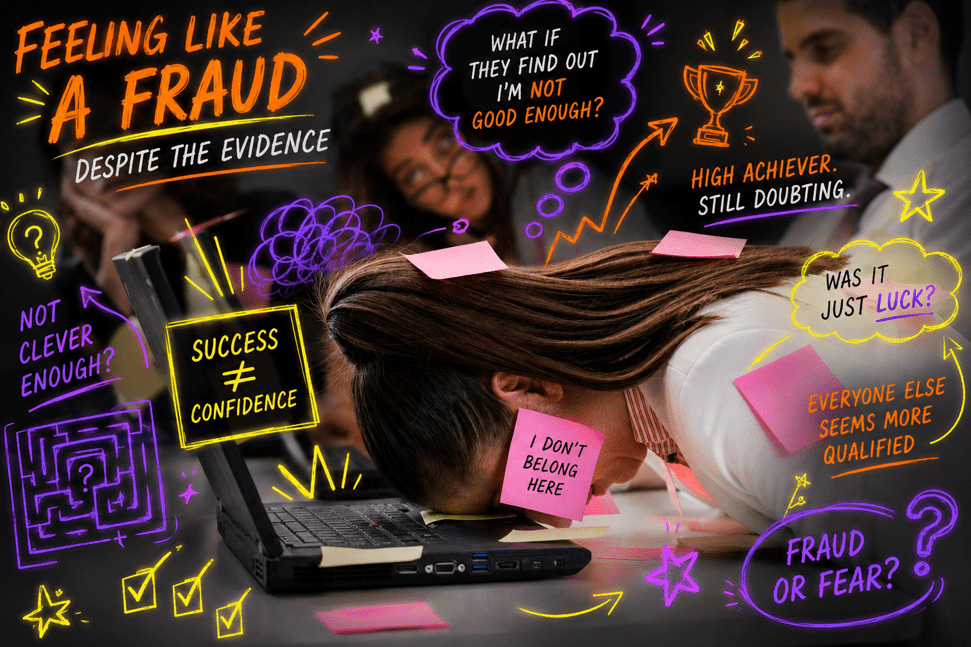
Dr Kate Atkin is now an expert researcher in ‘The Imposter Phenomenon’, which she defines as feeling like a fraud despite having the external evidence of success, something she felt early on in her career.
The woman who once feared she’d been found out now spends her career explaining why so many people feel the same way.
She says: “I’d been suffering from intense stomach aches at certain points in time. I mean, really intense.
“Now looking back on it they were probably anxiety, stomach aches caused by my own internal imposter feelings, but I didn’t have the language or the name for it.”
The National Institute for Health and Care Research found that 7 in 10 people are affected by the imposter phenomenon at some point in their lives, and in the UK, it’s thought that two-thirds of women have suffered from it at work in the last 12 months.
Dr Atkin says: “Imposter Phenomenon is a more accurate term than imposter syndrome, because it’s not a mental health condition, there is not something wrong with you.
“It is something that some people experience to various degrees. It’s experienced in different places to different intensities at different points in time, even by the same person.
“You are not a fraud, you are not an imposter, and you will never be found out.”
For those who are early in their careers, Dr Atkin says it is important to establish the difference between normal self-doubt and the imposter phenomenon.
She says: “When you’re starting out in your career, you’re new to the workplace. So, accept that some of normal self-doubt isn’t the same as imposter self-doubt.
“After about six months in a job, that tends to disappear, or at least lessen, you get to know the lie of the land. If that self-doubt is still high after six months, particularly after 12 months, then maybe it’s imposter style self-doubt.”
Imposter feelings are usually painted as the villain of the story. But what if they’re not entirely full of shit?
Some research suggests the Imposter Phenomenon may have an unexpected upside. Basima Tewfik, an assistant professor of Work and Organisation Studies at the Massachusetts Institute of Technology, has found that people who experience these doubts at work may actually make better colleagues.
They may be more empathetic, better listeners and less interested in proving they’re the smartest person in the room.
Which leaves us with a bit of a mindfuck: if imposter feelings can actually improve how we work with others, should we be trying to get rid of them at all?
Dr Atkin says: “I have a problem with embracing your imposter. I think what we should be doing instead is embracing our successes, embracing the feedback that we’ve had from others, and what we have built our knowledge, skills and experience to be.
“You can be successful. You can do a good job. You don’t have to have the underlying levels of anxiety that imposter feelings cause. I’m not saying we should never have any nerves, but we don’t need all of this intense feeling of phoniness when you’ve already got the track record of success.”
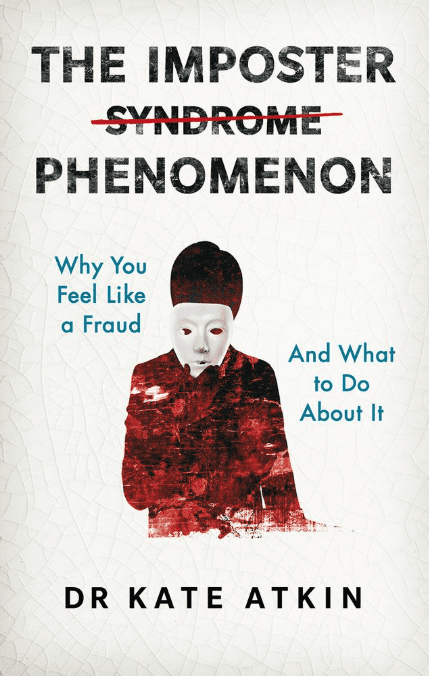
If the imposter phenomenon was hoping to keep Dr Atkin quiet, it certainly picked the wrong woman.
Since its release in June 2025, her book, The Imposter Phenomenon: Why You Feel Like a Fraud and What to Do About It, has outperformed sales targets and earned a nomination for a 2026 Business Book Award.
Yet even this wasn’t enough to silence that nagging voice. When she got the news, Kate says she still felt like a fraud.
“I just happened to quip to a friend and say, ‘Well, Pearson will have nominated all of the business books they published this year,’” she says.
Dr Atkin has spent years learning how to push back against the voice telling her she’s not good enough and how to stop treating every success like a lucky accident.
She says: “It’s about getting specific feedback and keeping the specific positive feedback of things that you have done well and reviewing that feedback on a regular basis to change the perception of yourself.
“Stop comparing yourself to others. It’s about stopping finding somebody better than you and start to look at how much you’ve developed.
“You should be looking and comparing yourself to yourself and looking at your own progression rather than looking at somebody else. Most of the time we look for the unfavourable comparisons.”
The British Psychological Society also suggests that building a professional support network can be helpful.
Whether it’s trusted colleagues, friends or a facebook group, having people to talk to matters. Because imposter feelings thrive in the dark.
The moment you realise others are dealing with the same shit, they start to lose their grip.
Because the real fraud isn’t the person questioning whether they’re good enough. It’s the voice insisting they’re not.