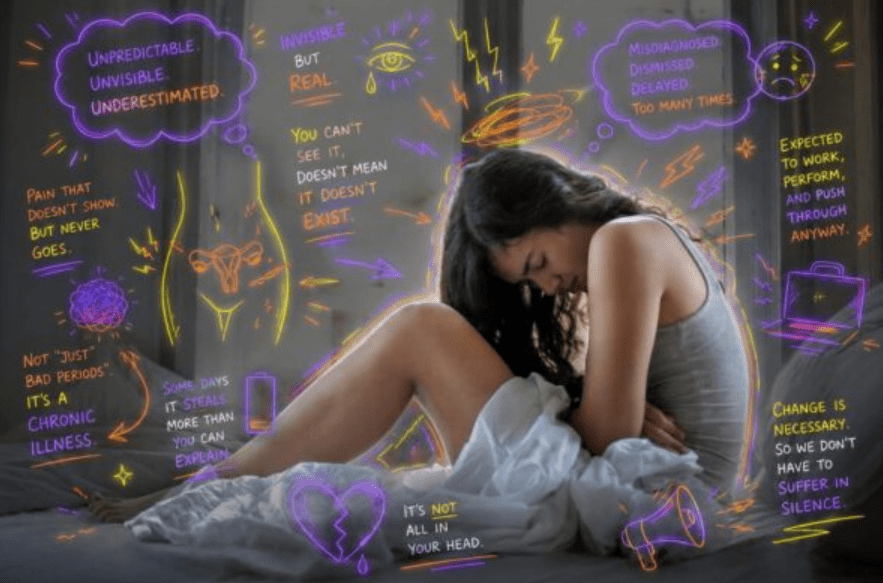

Nicole Simpson was sure she was dying.
Lying on her kitchen floor, caught in a severe flare, “in pain” was a generous description.
It didn’t matter.
She knew she’d be expected to finish her workday.
“I was in absolute agony,” she says. “Everything around me went muffled. I thought, ‘I’m either going to faint or throw up.’”
For women living with endometriosis, this is routine.
A debilitating condition is forced to coexist within workplaces that demand productivity and consistency.
According to Endometriosis UK, endometriosis affects one in ten women and takes up to nine years from the first GP appointment to receive a diagnosis.
Symptoms include severe menstrual pain, infertility, and abdominal bloating, with sexual intercourse, and mental health is also affected.
Nicole suffered for 10 years, only diagnosed through a laparoscopy surgery at 22.
“Working just gives me some kind of normality,” she says. “I definitely felt an element of guilt, because obviously I’m supposed to be working, and if I didn’t have health problems, this wouldn’t have happened. I did carry on working even after that incident and just pushed through to the end of the day.”
The pressure to ‘just keep going’ isn’t unusual.

Georgia Parratt, Principal Clinical Psychologist at the Manchester Pain Service, agrees.
“It’s a pattern of really intense pain, but pushing through it to try and get stuff done. You get a short-term dopamine hit, but it’s very quickly followed by guilt, shame, and pain flare-ups,” she says.
This works in a “boom and bust” cycle, where bursts of overexertion are followed by physical and mental crashes.
“It sort of works,” she says. “But you can only push for so long.”
On bad days, Nicole’s routine isn’t built around productivity; it’s built around survival.
“Each day is different. I wouldn’t say I really know what normal is,” she says.
One day, you’re cooking and exercising. The next, you’re flat on your back and feeling completely fucking useless.
This unpredictability can affect your personal life as much as your work.
“Everything takes thought and planning,” she says. “You can’t be impulsive. I can’t work and socialise on the same day; it’s ludicrous for me to even think about it. Where’s the nearest bathroom? How long can I stay? What if I need to leave? “It takes away spontaneity, it’s exhausting.”
Most people think burnout means shitty hours and an overflowing inbox.
The depletion that comes from having to function through chronic pain is a different beast entirely.
Women’s pain, in particular, is routinely dismissed, under-treated, and misunderstood.
“Women are much more likely to be dismissed as hysterical or dramatic or all of those gendered words that you don’t really hear used for men,” Parratt says.
Admitting how difficult it is isn’t always easy.
“I don’t like people knowing that I’m not feeling well,” Nicole says. “I don’t like sympathy. It’s easier to try and put a brave face on and give people what’s easier for them to tolerate.”
Consequences can be financial, too.
With limited sick pay, hospital appointments, inconsistent government support and the financial realities of having time off,
“How can rest be an option? You’ve got bills to pay,” Nicole says. “You can’t just go, ‘I’m not working today’. You’re juggling balls all the time.”
Her previous jobs in retail and fast food offered little flexibility.
“I found both employers to be extremely hostile, especially with hospital appointments or illness. I remember so many occasions when I’d be too unwell to call in and feel so guilty about it,” she says. “That’s how they make you feel. Like it’s your fault that you’re in pain.”
Nicole now works as a lending supervisor at a mortgage lender, in a more supportive role with adjusted hours and remote work.
“I still need to recognise that I do work even though I’m at home,” she says. “And if symptoms are high or I’m having a really bad pain day, that actually, I need to step back.”
Her employer, Nicola Boardman, Director of Sales Operations, wants to be part of the solution.
“Employees are our key assets. You can have the best system in the world, but it’s the people who make the difference,” she says.
Of course, it’s not all butterflies and rainbows; support is conditional.
While Boardman works with employees on well-being and provides adjustments to support them, these are subject to limitations.
“It’s difficult because you’ve got to have one lens on what is the best thing for that employee, but also what’s the best thing for the customer,” she says. “If we did that with everybody, there’d be nobody to answer the phone.”
@emilykateholistichealth #endometriosis #endometriosisawareness #chronicillness #chronicpain #endometriosissurgery #laparoscopyendometriosis #healing #womenshealth #periodpain #periodproblems #hormonalhealth #adenomyosis ♬ original sound – emilykateholistichealth
Parratt points to practical adjustments as essential rather than exceptional, under the Equality Act 2010.
“There’s still the idea that surgery is curative, or that it happens once a month. That misunderstanding has real consequences,” she says.
Endometriosis doesn’t work on a fucking schedule. It isn’t predictable, and it doesn’t align neatly with three-day leave and flexible rotas.
But when pain isn’t taken seriously, neither is rest.
Working from home allows Nicole to manage her symptoms in ways that were impossible before – but it’s clear this isn’t the norm. And that isn’t good enough.
The issue was never that women with chronic conditions can’t cope with work.
It’s that they are expected to work through a level of pain that would be deemed unacceptable in any other context – and to do so without complaint.
“Everything takes thought,” Nicole says.
It shouldn’t have to.