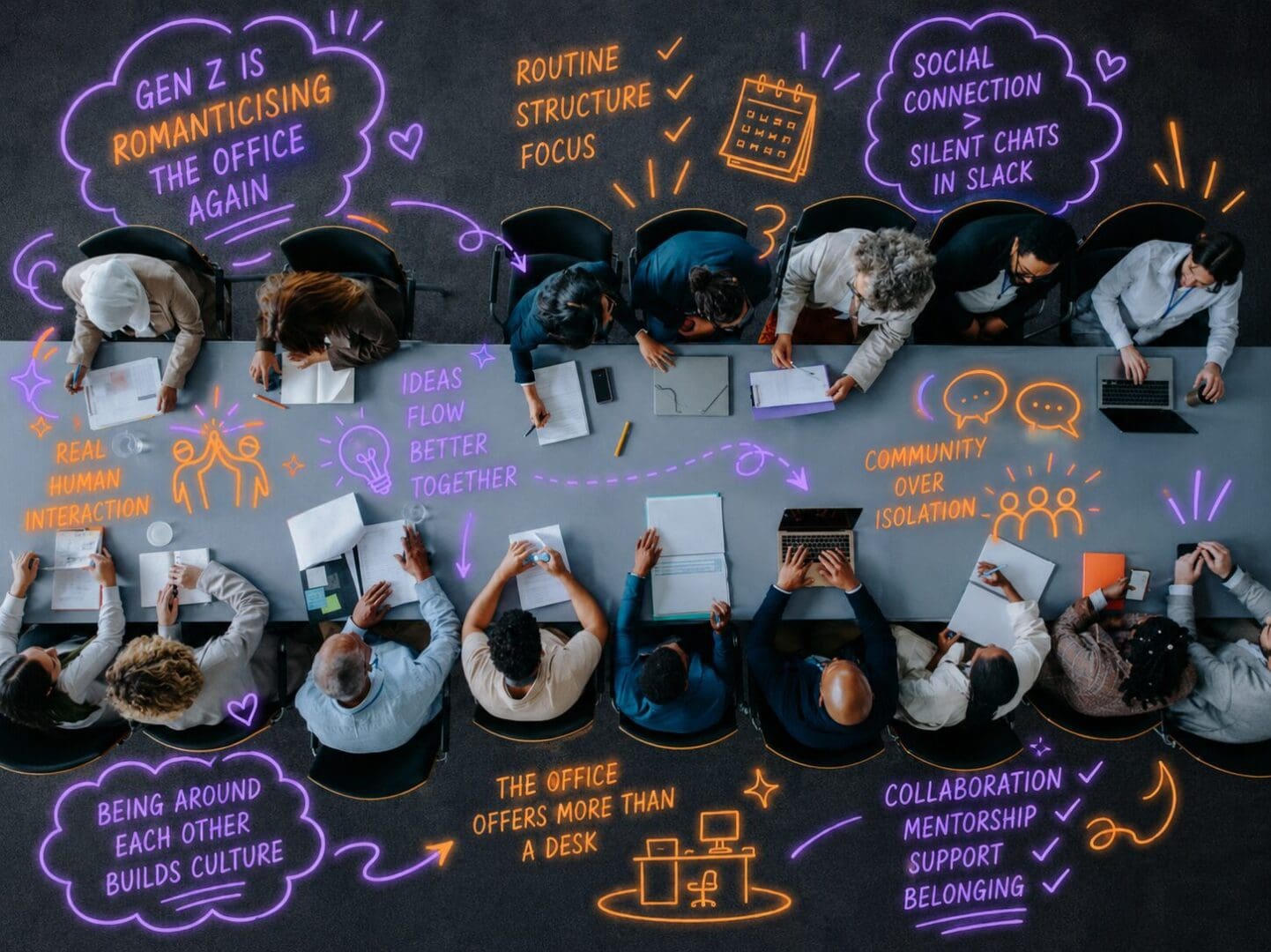

The office, a soul-sucking corporate wasteland, filled with awkward small talk, Pret subscriptions and fucking depression.
Then came remote work, and suddenly, freedom arrived, and it seemed as if everyone had escaped the so-called prison. Working from your bed in joggers became the new norm, and answering your emails from a cafe seemed revolutionary.
No commute and no bad-breathed manager hovering over your desk. For a while, it felt like the fucking dream.
But somewhere between the rise of hybrid working, the collapse of the graduate job market, and everyone losing their minds from permanent screen exposure, something changed. Gen Z began romanticising the office again.
Yes, it sounds bleak as fuck.
After years of isolation, zero routine and work taking over your home life, the office weirdly represented something comforting. Structure, human interaction, and a reason to leave the bloody house.
Largely, the interest stems from the trending ‘corporate core’ aesthetic; TikTok is flooded with ‘5-9s before my 9-5’ routines, overpriced iced coffees and colour-coded Outlook calendars.
@charlotte_katee Watch this video on TikTok
Watch on TikTok
According to workplace expert Bruce Daisley, “Gen Z remains the keenest audience to be in the office, after the C-suite.”
The key difference for many young workers is that the office isn’t just somewhere where you log on and answer emails, it’s where you learn how work actually works.
Remote work might offer flexibility, but it can also remove the informal interactions that quietly shape careers.
The overheard conversations, the confidence you build with one another, or the ability to ask a quick question.
“You know, humour really struggles remotely, the interactions sort of riffing off each other,” Daisley says. “Just actually seeing the way that something’s landed in someone else’s eyes.”
Professor Benjamin Voyer, Cartier Chaired Professor of Behavioural Science, agrees.
“Chance encounters, many genuine experiences are difficult to reproduce online, but chance encounters are simply impossible to,” he says. “And yet, they come with many benefits and make office life and office culture as unpredictable as exciting.”
A study done by The International Workplace Group also found that hybrid work can boost productivity by 11%.
“Typically, the one thing that we’ve found is that having a friend at work is the biggest predictor of whether you’re engaged with your job, and the levels of friendship at work are lower now than they’ve been in the past,” she says. “So we are definitely seeing a reduction in this. Gen Z workers, younger workers, typically have been the ones who’ve put effort into trying to build friendships and trying to build those connections”
Professor Benjamin says many young workers also feel they missed out on formative workplace experiences during the pandemic.
“There is FOMO reported on having missed out on in-office experiences for all those who graduated during the pandemic,” he says. “The difficult job market is making office and culture experience even more valuable for young graduates.”
The office also provides something rare in modern life: separation.
The biggest criticism of remote work is how completely it has blurred the boundaries between work and personal life. Your bedroom becomes your office, your laptop becomes an extension of your nervous system, and you answer emails while watching Netflix in the evening.
Your brain can no fucking longer switch off.
“A ping from a colleague can be responded to while you’re watching TV,” Voyer says. “It means it’s much harder to switch off. Getting a regular office routine is a big deal for someone who wants to move up the career ladder.”
The office is no longer viewed solely as a corporate obligation. For many young workers, it represents progression, social connection and a clear distinction between life and work.
After years of isolation and endless notifications, even the headache-inducing office lighting is beginning to feel appealing.