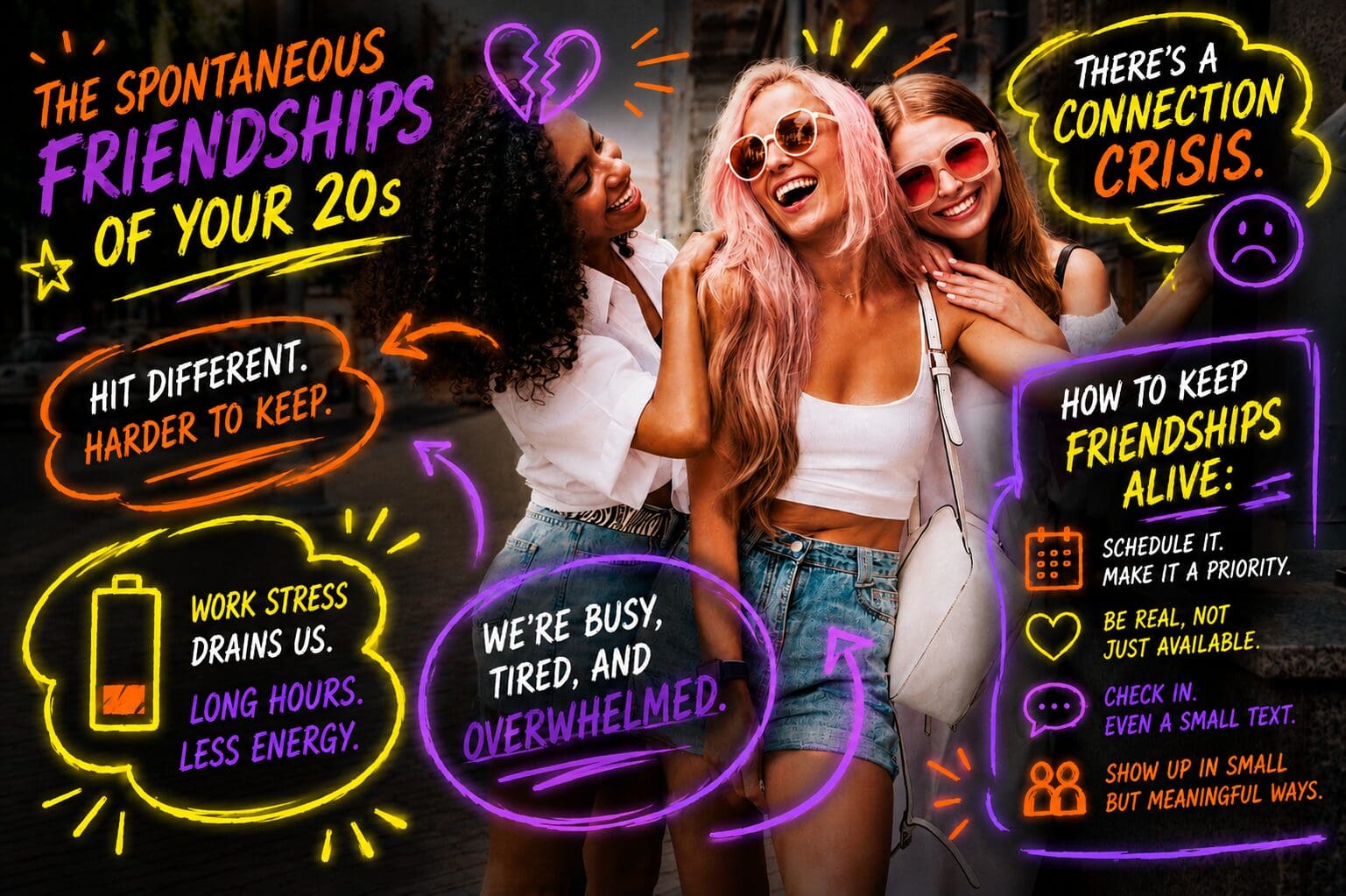

As we move through adulthood, we start clocking all the things we took for granted when we were younger. One of the biggest? The luxury of casual, spontaneous friendship.
Back when you’d show up to school or university and your entire friendship group was literally in one room, a social miracle that now feels about as common as a fucking lunar eclipse once work, life chaos and everything in between gets in the way.

Kelly Brooke Martinez, a 27 year old waitress says: “As a teenager, I always viewed adult friendships as pretty much what I saw on TV, like Sex and the City or even Gossip Girls, or Friends. They all just live in the same apartment complex, pop round to each other’s apartments and meet at the same coffee shop every day.
“I was like, yeah, me and my friends are going to do that. But that’s just not the reality. I think there is a really hard grieving period that comes along when the facade of what you think your future will look like slowly falls down.”
The friendship we grew up with the ones we imagined would follow us into adulthood, fade without us noticing. And when work becomes so all‑consuming, even organising a simple catch‑up can feel like yet another piece of admin on an already heaving to-do list.
But psychologists tell us that friendship isn’t just an optional extra, it’s literally wired into our survival kit.
Dr Niobe Way is a Professor of Developmental Psychology and has been studying social and emotional development for nearly 40 years. She says that as humans, relationships are our most fundamental need.
She says: “All humans are social animals, and friendships play a key role. We need each other, we wouldn’t get food and water if we didn’t have relationships as a baby. Research also reveals that we are born with the natural skills to have these relationships.”
“Young people link specifically mental health problems with not having friendships, but mental health is not the problem. It’s a symptom of a social health problem.
“But in our culture we don’t even have the concept of social health. It doesn’t even exist in our public health discussion. But what young people have been teaching us in my research is that social health predicts mental and physical health problems. You can die from loneliness.”
Dr Way says that as we get older, we hit a “crisis of connection”, a point where maintaining friendships becomes a whole lot tougher. And the reasons behind that shift look very different for men and women.
She says: “The crisis of connection with boys is not having the friendships that they want. For girls, the crisis of connection looks different, because we are raised in a patriarchal culture.
“What girls do is they disconnect from what they know and feel and fake it in relationships, which means their crisis of connection is actually to themselves.”
Even though the research couldn’t be clearer about how vital friendship is for our wellbeing, this crisis of connection keeps showing up.
And a lot of it traces back to the same old culprit that seems to script half of our lives: the fucking patriarchy.
“In modern culture, which I call an anti-social culture, there is a set of ideologies, hierarchies and stereotypes that make thinking masculine and feeling feminine, privileging only the stereotypically masculine sides of ourselves over the stereotypically feminine sides,” Dr Way says.
“We value cognition over feeling. And people think that’s only true for men. Are you kidding me? It’s just as true for women.
“Girls and women feel the pressure to man up at this point in our culture as much as boys and men. The whole ideology of being the kick-ass who doesn’t need other people. That’s all stereotypically masculine bullshit.”
Translation: we grew up in a system that glorifies detachment and sidelines emotion, a patriarchal rulebook that tells us to toughen up and go it alone. That obsession with independence turns into isolation, no wonder connection slips.
That disconnection doesn’t happen in a vacuum. It only gets worse in a culture that tells us our worth lives in our productivity. So many women can’t switch off without feeling guilty, like rest is some kind of moral failure.
When you’re stuck in that mindset, it’s no wonder friendship slips even further through the cracks.
Kelly says: “My social life used to feel like a chore. It felt emotionally draining and it always felt like my battery was lower after hanging out with someone. I mean this sounds so cold, but it felt like wasted potential.
“You know, what else could I have been doing? Maybe I could have been doing something more ‘productive’ like applying for a job that could have been my dream career.”
But after some painful, perspective‑shifting moments, Kelly found herself facing a wake‑up call she couldn’t ignore.
She says: “I had lost this dream job that I had out of nowhere, a job I had committed four years of my life to and moved states for, and I lost it out of nowhere. I was one of the top performers, and one day they said, ‘hey, you’re fired’. That was a really tough time in my life.
“I also had a close friend of mine pass away very suddenly. It all just made me think just how fickle life is. No one is promised tomorrow. Given the fact that this was so sudden and made me realise that this could happen to anyone.
“All I had to show for my life was my work which I got fired from, so what really was my life worth living for? After that, I made a very conscious decision to start working to live and not living to work and realized just how important those friendships are.”
To keep those friendships alive in adulthood, Kelly says it really comes down to making the effort, even when your mind is begging you to cancel, retreat, and pretend you’re busy.
“It sounds cliche, but to have a village, you have to be a villager. I found for myself that even when my social battery is drained because of work, if I still make the active choice to hang out with friends or respond to texts or pick up the phone when someone calls, I feel 10 times better afterwards than I did before, even though my social battery was drained.
“Be a villager even if it makes you uncomfortable.”
@kellybrooke.m Kelly is having a rot day. also if ur my friend this is a gentle reminder that I love u to the moon and back #friends #effort #relationships #friendship #community ♬ Dust Collector – ybg lucas
Anna Goldfarb, a friendship expert and author of Modern Friendship, says that friendships are more difficult in today’s society than ever.
She says: “We live in a very hyperfluid culture. We move around more, we’re more dynamic. We can move to a new city, we can go to college, we can meet all sorts of people from all different backgrounds. And that’s historically new.
“Your great grandmother probably lived in a little town where she didn’t have to try so hard to keep her friendships going. She probably had friendships from childhood that just lived in the same town and didn’t have to negotiate so much. It makes total sense that friendships are more complicated because our identities are more complicated.”
There’s a phrase floating around online at the moment: “catch‑up culture”. You know, that thing where you finally see your friends after half a year and end up cramming every major life event into one chaotic debrief over a lukewarm latte.
Goldfarb says this is part of why friendship loses its spark and starts edging into feeling more like another item on your to do list. It’s less enjoyable, it’s admin dressed up as quality time.

If you want the real thing, she says scrap the boring admin‑coded catch‑ups and do something that’s intentional and actually fucking fun.
She says: “For the hangouts that get on the books, it’s like, what’s in it for me? What am I going to get out of it? Am I going to do something I enjoy? Am I going to do something that’s fun for me? Something I wanted to do anyway?”
She also stresses that the way you reach out isn’t a small detail, it can totally make or break the connection.
“It’s about being low pressure and it’s giving people more information. When we were younger, ‘Are you around Friday?’ worked but that’s not gonna cut it for an adult.
“Like what are you asking? What do you need? What time are you thinking? Is it gonna cost money? Where are we going? Part of cutting down on admin is giving people more information so that they can say yes quicker.”
Dr Way says the secret to maintaining human connection is asking the right questions.
She says: “It’s called interpersonal curiosity, the curiosity about the thoughts and feelings of each other and experiences of each other. What we find from our studies is that people are starving to be asked questions.
“And you know what questions they’re starving to be asked: what do you care about? What do you value? When do you feel happy? Tell me about a time you felt listened to, tell me where you belong. It’s because they want to be seen as they see themselves and not the way you stereotype me to be.”
But even if you’re doing everything ‘perfectly’, friendships are still going to move, stretch and change shape. That’s adulthood. No amount of fun days out or meaningful chats can freeze them in place. It’s a hard fucking truth, but it’s the truth.
Goldfarb puts it plainly: “The realistic expectation is that things are going to change. It’s going to be different and it’s on us to be open to what it could look like now.
“It’s unavoidable. No one’s doing anything wrong. But it’s mellowing. It goes from grape juice to wine.”
She also calls out the way we hang onto friendships for nostalgia’s sake, even when they’ve stopped fitting our lives and reminds us that letting go is a valid choice.
“Not every friendship needs to be preserved forever,” she says. “When interviewing people for my book a lot of them told me, they wished it was more acceptable to just say, ‘I wish you well, no hard feelings.’”
Unfortunately, friendships don’t stay frozen in time and pretending they should only make the natural shifts feel like personal failures. They change, they stretch, they mellow, and sometimes they end. Not every friendship is meant to be preserved forever. The grown‑up move is accepting the shape it takes now, not clinging to what it used to be.