
You’re sitting at your desk. Half thinking about the next fucking google meets call you have to join, half regretting the sandwich you just inhaled in 90 seconds.
All day, the tight, uncomfortable swell in your stomach has made you want to hide in a baggy hoodie and pretend it’s ‘just cold in the office’. Sound familiar? You’re not alone.
Research shows that 40.3% of adults suffer with gut health issues, and stress and anxiety is often a root cause.
Dr Alexa Duff, is a Clinical Psychologist who specialises in supporting those with gut health difficulties says: “Stress and anxiety trigger the sympathetic nervous system which controls all the functions in our body required for ‘fight or flight’.
“When we are in fight or flight mode, our digestion is suppressed because it isn’t a necessary function to escape the danger that our nervous system thinks that we are under.”
Your mind and digestive system are in constant conversation through the gut-brain axis, a two‑way messaging line between your central nervous system and the enteric nervous system in your gut.
Dr Duff says: “The relationship between the gut and the brain is bidirectional so people with gut disorders are more likely to experience mental health struggles and vice versa.”
And shocker: the effects hit women harder, mostly due to our hormones. Research shows we’re 1.7 times more likely to have digestive issues and 2.5 times more likely to develop IBS. Lucky us, as if we didn’t already have enough shit going on.
A Cambridge University study found that work stress is in fact the number‑one culprit behind negative digestive symptoms.
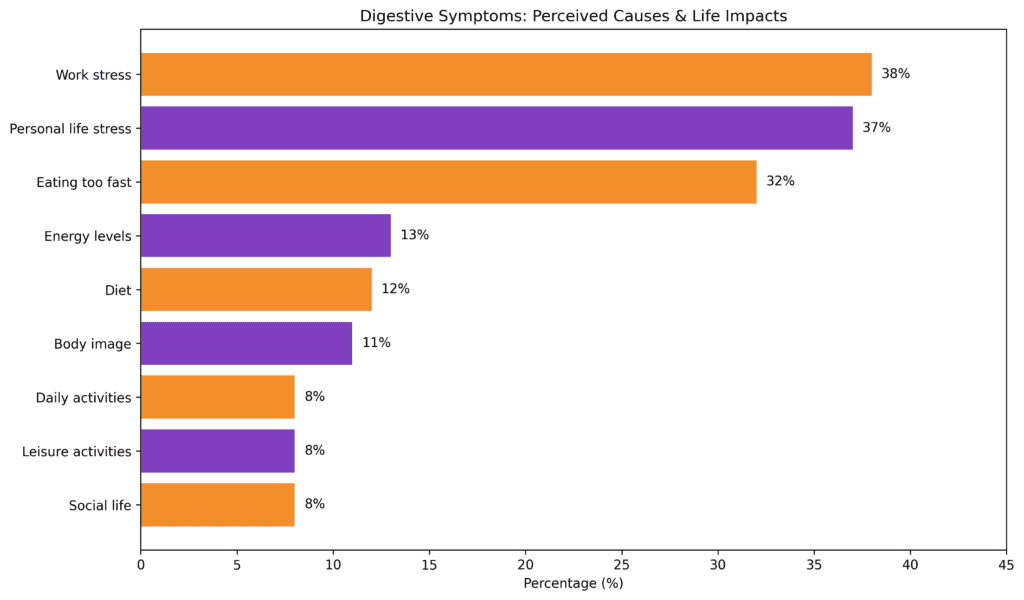
Dr Duff points out that being glued to a desk all day usually means more stress, and your gut feels the impact.
“There may be stressors associated with jobs where constant sitting is required like being ‘on call’ all the time with emails which will disrupt the gut brain communication,” she says. “Also, movement really helps to stimulate normal bowel activity.”
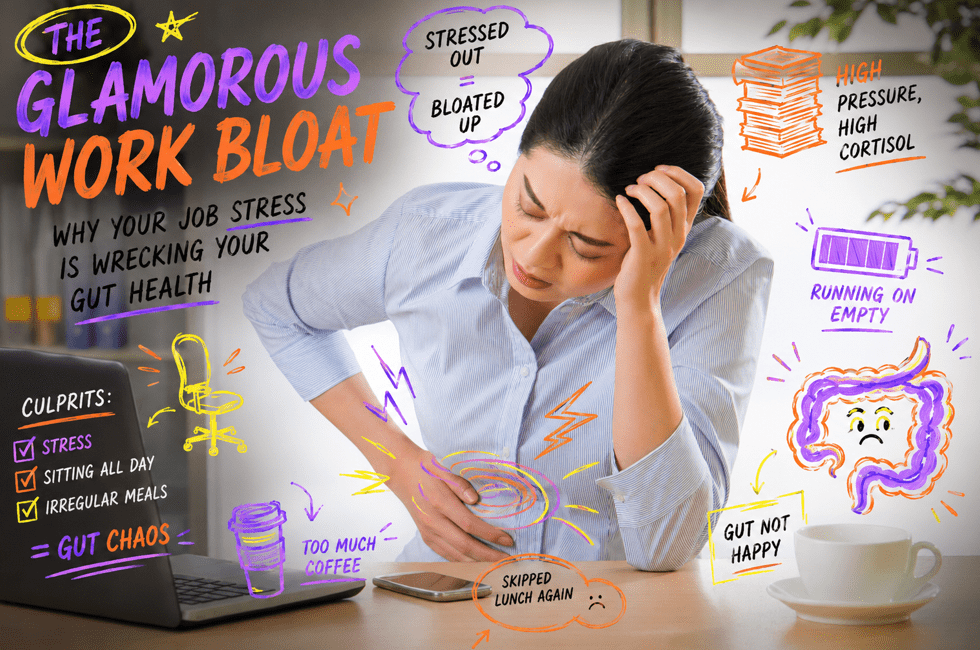
On top of that, the chaotic eating habits that often come with the job don’t exactly set you up for success. One minute we’re skipping lunch, the next we’re stress‑snacking and then we’re grabbing a few rushed bites of whatever’s closest in the tiny gap between meetings.
Even though it’s not always something we can control, your gut is understandably like, ‘What the hell do you expect me to do with this?’
Dr Duff says: “Eating in this state means that it is harder for the body to properly digest food.
“Eating too little and irregular eating patterns, also make it harder for the body to regulate blood sugar and to have enough energy to function, both of which will also activate a stress response.”
And with hustle culture and the glamorised performance of being permanently ‘busy’ dominating social media, modern work culture is basically pouring fuel on the fire.
“For our digestive system to work effectively, our parasympathetic nervous system needs to be engaged and we need to be relaxed for this to happen,” Dr Duff says.
“Without an opportunity to wind down from stressors that our body and brain has experienced, the digestive system does not have a chance to work as it should.”
It’s a vicious cycle. Stress means you don’t eat. Your digestive system stops functioning properly. And suddenly you’re even more stressed.
But the good news? There are actually some simple ways to fight back.
I’m going to hold your hand when I say this, but Dr Duff’s first tip is to ditch the emotional support water bottle.
She says: “Move and hydrate, get up to get a glass or water at regular intervals rather than sitting drinking from a large bottle, this will build in screen breaks and movement.”
She also suggests a few simple eating habits that genuinely help. Nothing too dramatic, just stepping away from your laptop for a few minutes, which shouldn’t feel rebellious, but somehow does in modern working culture.
“I suggest taking a 10 minute walk after meals, eating at regular intervals and eating with friends or colleagues rather than while working.” she says.
There are also a few things you can do outside of work, the non‑negotiables we forget we’re actually allowed to have.
Dr Duff says: “Prioritise sleep, we need at least seven to nine hours a night.
“Exercise, while great for health, is also a stressor so you may want to consider switching it up and trying exercises that help you to wind down as well as high intensity exercise.
“Consider your alcohol intake, it is bad for the gut and the brain, have a few nights a week off and limit your intake when you are drinking.”
Your gut isn’t failing you; it’s trying to keep up with a world that never slows down. And while you can’t fix the entire culture of overwork, you can make space for the habits that help you feel human again.
A walk. A real lunch. A bedtime that isn’t a suggestion. Little things, but they add up, and your gut feels every single one.