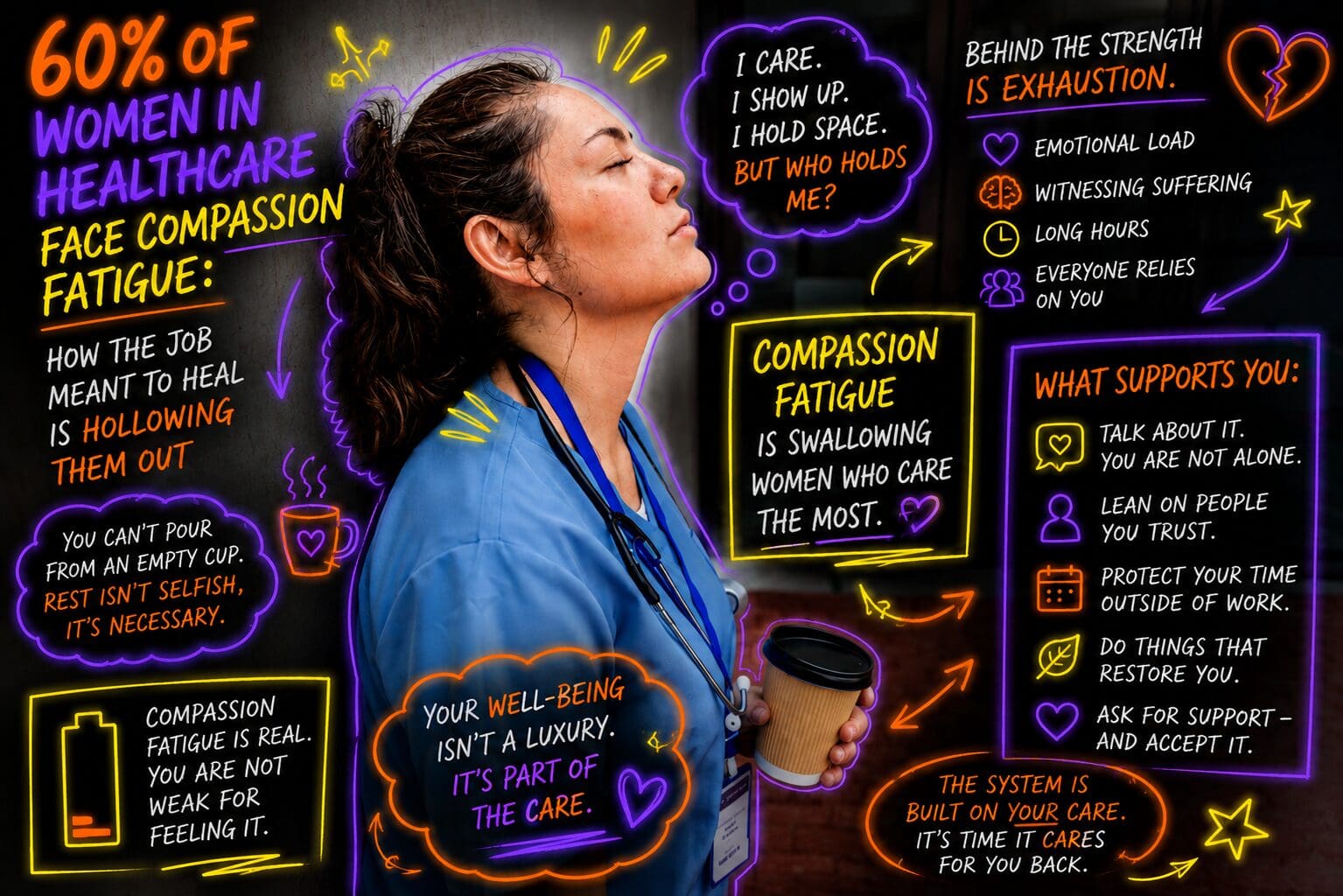

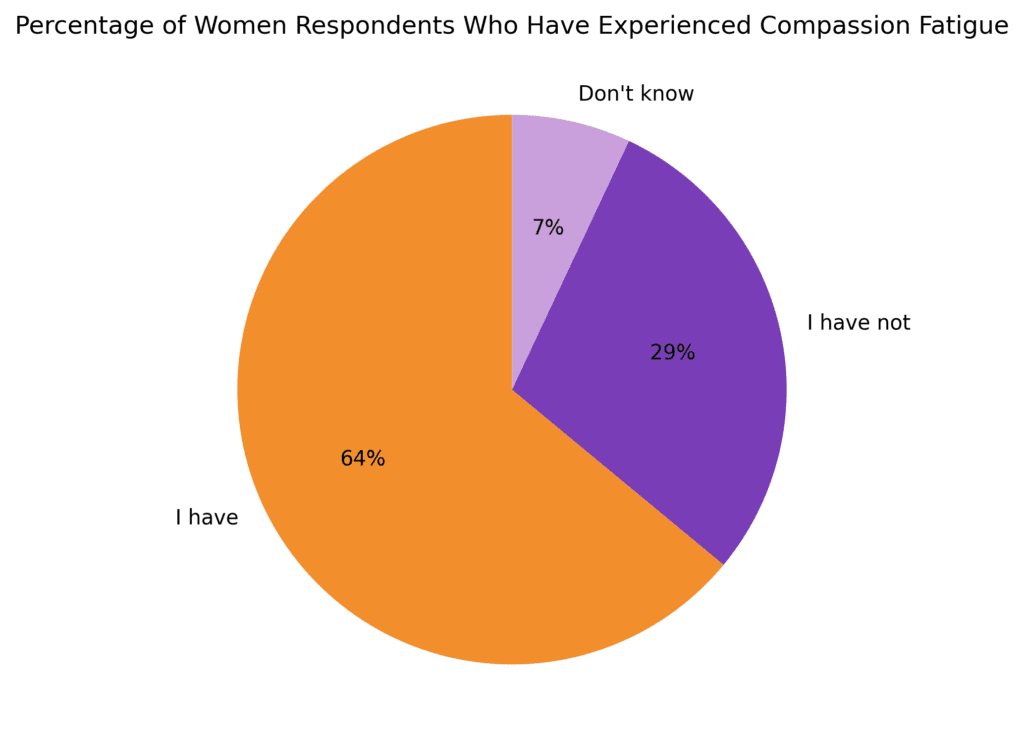
A 2024 survey from the The Medical and Dental Defence Union of Scotland (MDDUS) found that 64% of women in healthcare professions have experienced compassion fatigue as a result of their job.
They define compassion fatigue as “the emotional cost of caring for others and prolonged exposure to the suffering and trauma of patients. It creates a loss of satisfaction from doing one’s job well and decreased ability to empathise with patients.”
Translation: women in healthcare aren’t just tired, they’re internalising the suffering they see everyday surviving on emotional scraps while still being expected to smile, steady the room and pretend they’re not falling apart too.

40 year old Kristel Nieves, a Critical Care Nurse has experienced compassion fatigue throughout her career.
“Taking care of really sick patients takes a toll on you because you’re literally fighting death every minute of your shift. In the long run, you forget to feel, and therefore you end up losing a degree of compassion for your patients.
“You lose the energy to listen, not just hear words but to actually listen, understand, empathize with people who are actually talking to you.
With 64% of women saying compassion fatigue affects how they communicate with patients, and 41% worried it could compromise their ability to practise safely, it’s obvious this isn’t just a ‘wellbeing issue’, it’s a warning light flashing across the whole system.
So the real question is: how do we stop a job built on caring from breaking the very people who keep it standing?
Dr Josephine Braid is a Doctor and Burnout Recovery Coach for medical professionals and also the host of the Burnout Recovery Podcast.
She says: “Compassion fatigue is like you saying, I genuinely cannot care for one more person’s problem right now, including my own.
“Healthcare workers are trained to spot the signs of somebody being unwell, but they find it hard to look at it in themselves. It’s a bit like being a car mechanic who hasn’t serviced their car for four years.”
She says compassion fatigue is tricky to recognise, the warning signs overlap so closely with high stress that the symptoms blur into one exhausting mess.
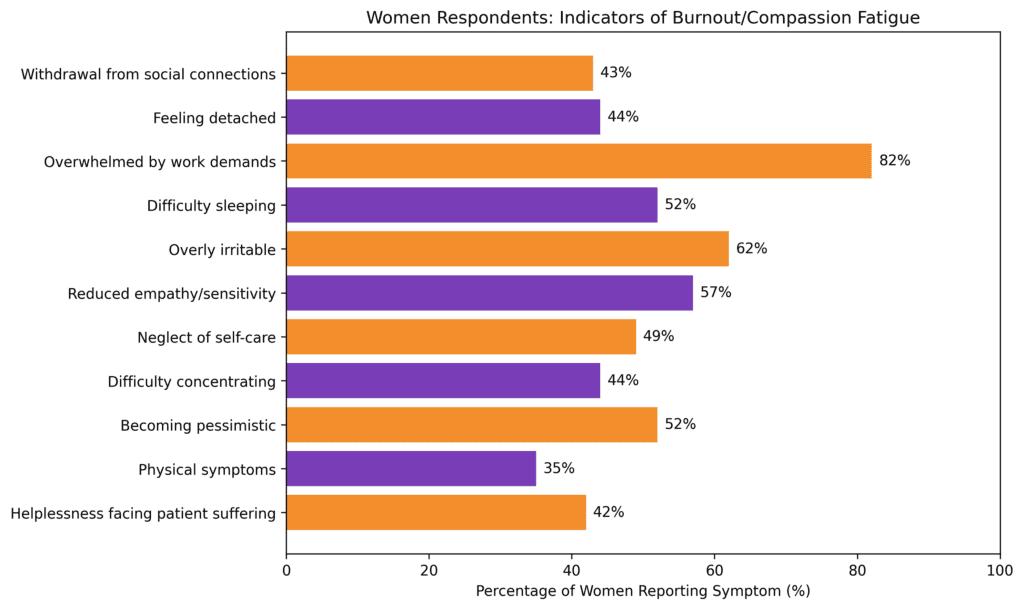
The MDDUS survey found that the most common signs of compassion fatigue in women were feeling overwhelmed and exhausted by work demands, becoming overly irritable, becoming pessimistic and also having trouble sleeping.
Some other symptoms may include: “Experiencing headaches and a suppressed immune system meaning you might get more frequent illnesses,” Dr Braid says.
“Behaviourally, I talk a lot about Sunday dread, if you’ve got a Monday start. You might try and numb out, for example with alcohol, drugs or food.”
There are a few symptoms that stand out as specific to this strain of stress.
Dr Braid says: “You may find yourself speaking quite negatively about your patients and your work. You might care less about other people’s emotions and you might find yourself withdrawing from your team, your family and loved ones.”
The symptoms can fuck with you in all kinds of ways that we might not always clock, and for medical professionals the weight hits brutally deep, not because they’re weak, but because the job demands a level of emotional exposure no one can walk through untouched.
@hello.drjamie If you’re in healthcare and you’ve been feeling more irritable, more tired, or a little disconnected lately— this might be why. Send help
♬ original sound – Dr. Jamie, Dentist
Dental resident Dr Jamie Castro says she often feels the pressure to power through compassion fatigue, because the profession has a way of teaching you to push past your limits long before you learn how to protect them.
“It’s hard to admit that we’re struggling if those in the workplace who are supposed to support us don’t,” she says. “Why waste that time and energy admitting we’re struggling when no one will do anything to change it?
“I don’t want to let any of my patients down or disappoint them. I feel the need to show up for them and put my feelings aside.
“It’s probably difficult for medical professionals to recognise because it’s a pride thing. They don’t want to be seen as weak in front of people that look up to them for answers to make them feel better.”
At some point, the system that keeps these women running on empty has to answer for the damage, for enabling conditions where exhaustion is the baseline and survival mode isn’t a crisis response but the only operating system they’re allowed to run.
Jamie says: “Realistic staffing is a big thing. When we are short staffed and have a jam packed schedule there’s no way to give high-quality care.
“Patients then don’t feel valued and in turn treat the provider poorly when in reality the provider is truly doing their best to give the best care in such a time crunch. One poor interaction with a patient can begin to build-up and lead to compassion fatigue.”
Although awareness is improving, a long overdue step in the right direction, it doesn’t magically fix the shit people are dealing with on the ground.
“Before, no one would talk about it. There’s so much awareness now, but I think we need more action. How do we help these providers? How can we prevent this?” Jamie says.
“We need more sources and support from others so we as healthcare workers can be present for our patients.”
For Kristel, compassion fatigue doesn’t stay politely at the hospital doors, it crashes straight into her personal and family life.
She says: “I went through a period of depression where I felt emotionally depleted from work and it spilled over being emotionally depleted in my own personal life.
“At the time I was a new Mum too, and I think it also coincided with a bout of postpartum depression. It was like I was never enough for anyone.”
And as a woman and a mother, the weight is doubled, because the patriarchy still acts like women were born with a built-in customer‑service department for everyone else’s emotions.
“It’s a lot on my shoulders to have the weight of caregiving, empathy, sympathy, compassion, all at the same time, everywhere, at work and at home,” Kristel says. “It’s a lot to take on as a woman. And the added pressure of expectation of doing it all and doing it all with pride.”
As simple as it sounds, Kristel swears by the power of leaning on your circle. Even when your brain insists you’re being a burden, that’s bullshit whispered by exhaustion, not anything grounded in reality.
She says: “I cannot stress enough how important it is to have someone to talk to and confide in! My number one support is my husband. He makes sure I have a space to vent, whenever necessary.
“I am grateful that I work with a group of awesome nurses who I consider friends. They’re the only people who understand what I’m going through at work. And it’s always nice to talk to people who just understands without having to fully explain.”
@nocnocitskris Compassion fatigue is realllllll #nurse #nurses #nurseproblems #RN #registerednurse #ICU #ICUnurse #nightshift #nightshiftnurse #nursing #nurselife #nursehumor ♬ original sound – soffeloffe
Dr Braid says recovery often starts with the basics: sleep, movement, eating well. I know, it sounds almost insultingly simple. But when you’re running on fumes, even the ‘easy’ shit feels like climbing Everest and it ends up being the stuff that actually keeps you standing.
“They are things that seem so obvious, but they are non-negotiables and I treat them almost like a prescription,” she says.
“I also believe in doing micro practices, just small things that don’t take that long for you. That’s only like maybe a 1% change rather than going for a 25% to 50% overhaul.
“There’s lots of different breathing techniques. There is a four, seven, eight breathing technique. So inhale for four, hold for seven and a really long exhale for eight. Step outside if you can for just five minutes, these are really helpful for our nervous system.
Dr Braid also preaches the importance of separating home from work, which, let’s be honest, is one of those things that’s far easier to say than to actually pull off when your brain is still replaying your shift at 2am.
“Even getting a little ritual around leaving the workplace before you enter home so you don’t bring some of your attention from work into the home,” she says.
“You could do the breathing routine or go for a walk before you come home and getting out of the work related clothes that you’ve been wearing is important.”
Although we do have coping mechanisms that can soften the blow of compassion fatigue, the real shift has to come from the top.
“Individual resilience training without changing the organisation structurally is like being in a sinking ship and handing somebody a bucket, the ship actually needs fixing,” Dr Braid says.
“They need to embed wellbeing into the governance level. It needs to be really coming in from executives that it really matters how the wellbeing of all of our staff are and managers or seniors need to lead with that.
“We need to check how people are doing, ideally with metrics as well, doing some scores, seeing how they’re managing. We can look at turnover rates. We can see how much sick leave there is.”

We need to push for the system to change. Keep having conversations. Keep backing each other. And even when it feels intimidating, keep bringing it to your managers, because silence only protects the status quo.
Kristel has learnt that even when working in a job that is centred on taking care of others, you need to put yourself first.
She says: “I’m here to remind you that you are your most important patient. The reality is having compassion means giving a little bit of yourself to another person but having to constantly do that day in and day out, you can easily lose yourself.
“Pouring from an empty cup doesn’t benefit anybody. Take care of yourself first, be your own advocate, and in turn you will be stronger and better at helping others.”