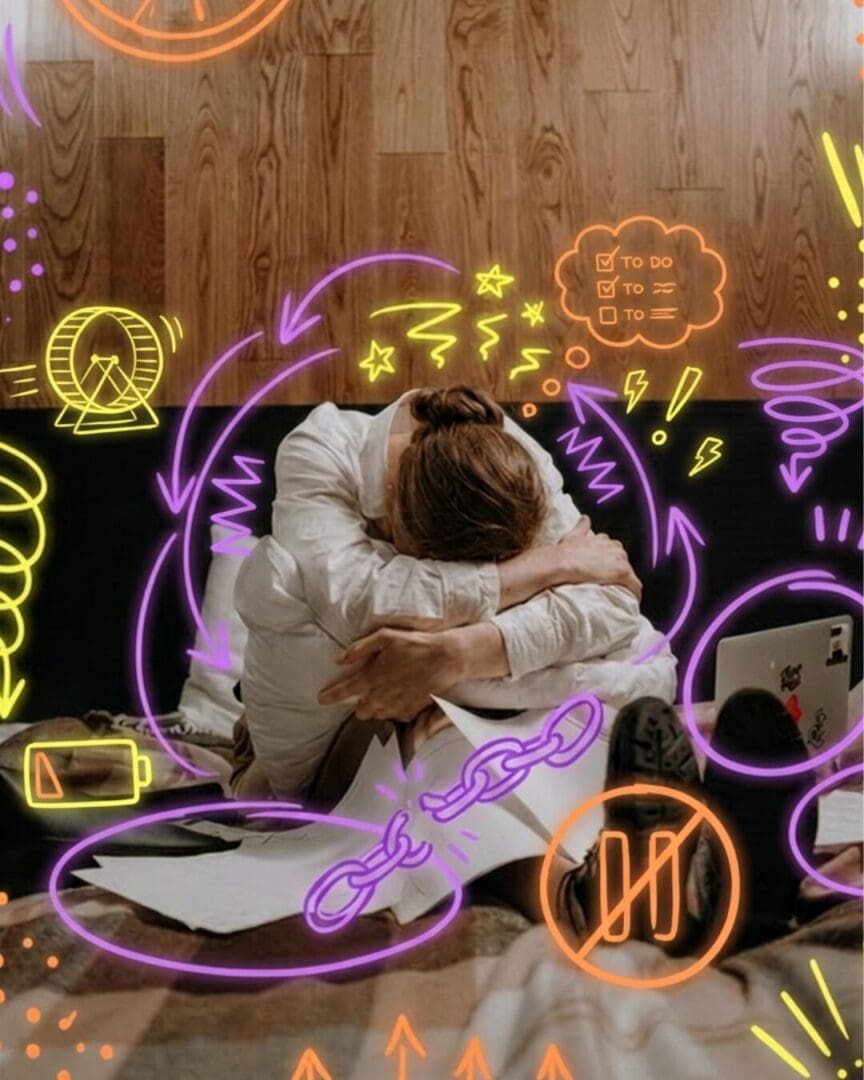
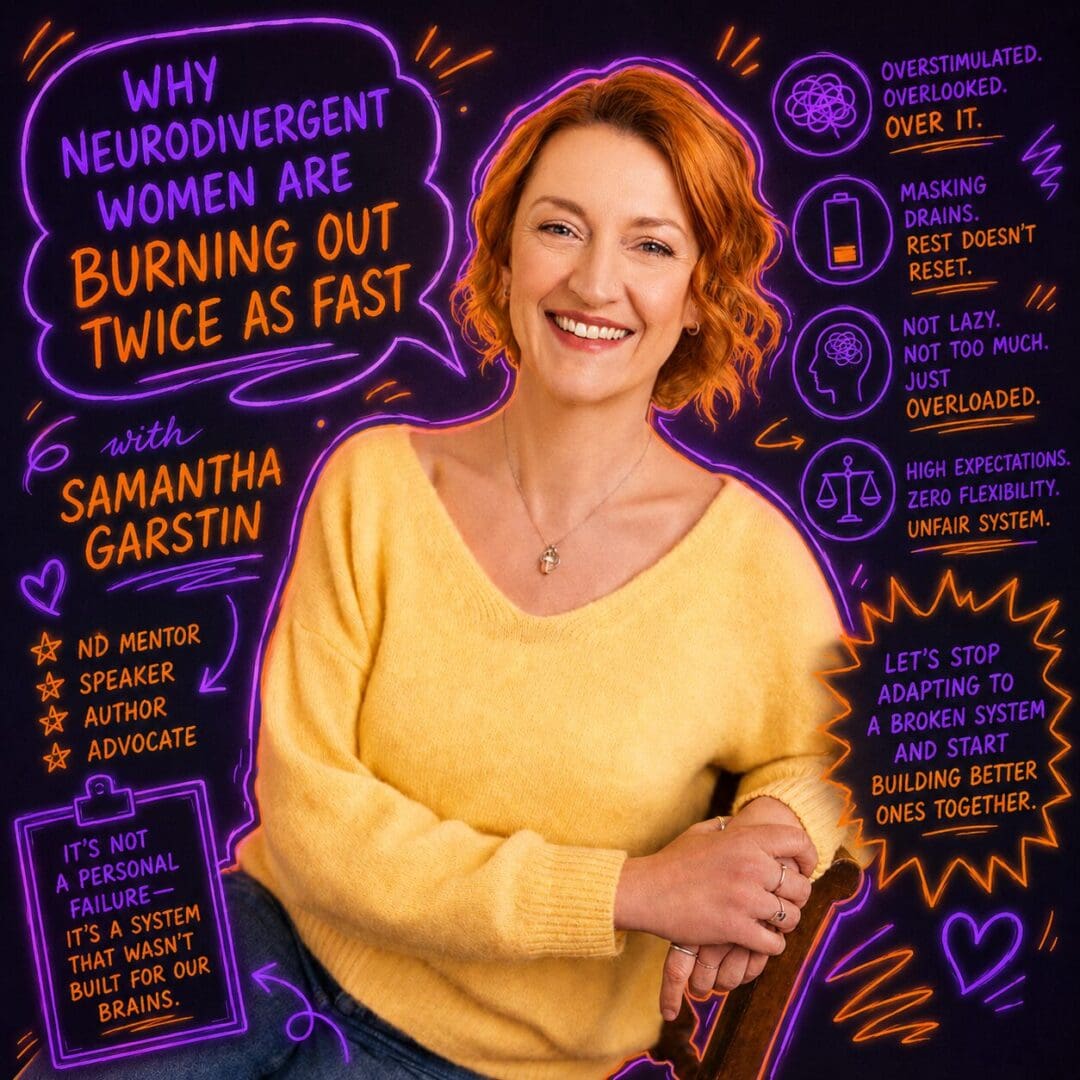

Samantha Garstin remembers the moment with brutal clarity. Open-plan office. Fluorescent lights humming overhead. Phones ringing. Keyboards clacking. Her manager was hovering near her desk, waiting for an answer she couldn’t form because her brain had completely shut down.
And then: full-body sobbing. The kind you can’t hide in a toilet cubicle. The kind that gets you sent home.
“I thought I was just nuts,” Samantha says now, years later. “I kept having these complete meltdowns at work, and I couldn’t understand why. Like, what’s wrong with me? Why can I not just… function?”
The answer, it turned out, wasn’t that anything was wrong with her. The answer was that she’s autistic, and the modern office was designed to systematically destroy people exactly like her.
Today, Samantha is a Menstrual Education Coach, Inclusion Specialist, and founder of Menstrual WISE Coaching. Based in Salisbury, she leads the Bloody Marvellous Menstrual Workshops, working with progressive businesses to dismantle period stigma and build workplaces that actually account for the bodies and brains. Known as ‘The Period Princess’, she is an advocate who’s built a platform teaching women about menstrual cycles, hormonal health, and the revolutionary idea that maybe, just maybe, your body isn’t the problem. The 9-to-5 is.
Diagnosed with autism and ADHD at 43, Samantha’s mission sits at the intersection most workplace wellness conversations refuse to touch: how neurodivergence and menstrual cycles collide, and why ignoring that intersection is breaking women at scale.
But her real mission goes deeper than cycle-syncing. She’s fighting for something the corporate world is desperately trying to avoid: acknowledging that neurodivergent women are carrying a double burden that’s burning them out at catastrophic rates. And the ‘accommodations’ being offered aren’t nearly enough.
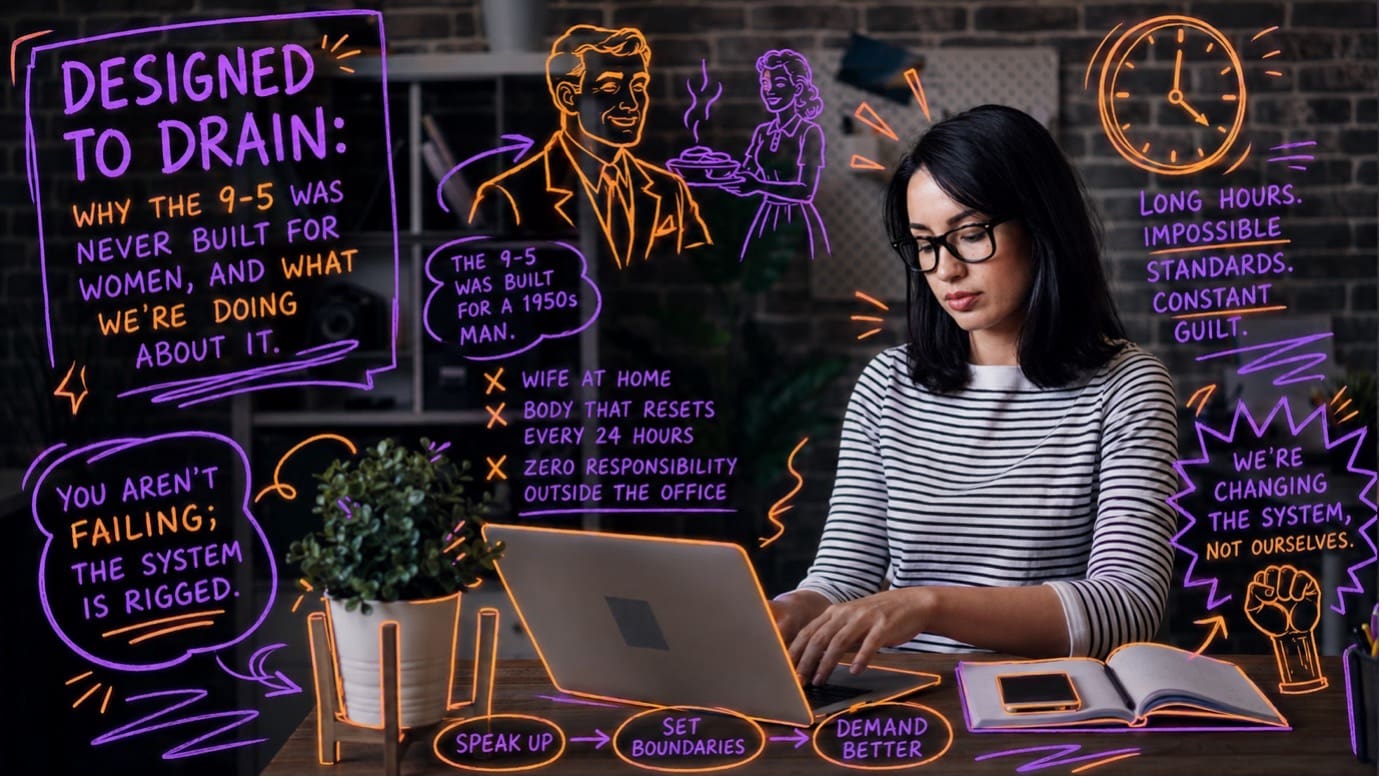
The nine-to-five workday was built before women were in the workforce in significant numbers. That is not opinion. That is a historical fact. And it was definitely built before anyone gave a shit about neurodivergent brains.
“The world of work mirrors the testosterone cycle, which is on a 24-hour rhythm,” Samantha says. “It mirrors the circadian rhythm. And it’s built for neurotypical brains and how they work. So, when you show up with a brain that doesn’t get going till noon, or with hormones that fluctuate across a 28-day cycle, you’re being asked to work against your internal design.”
For neurotypical women navigating a menstrual cycle, that’s already brutal. The research on how the rigid corporate clock punishes female biology is mounting. We’ve covered it extensively. But for neurodivergent women? It’s a fucking catastrophe.
“You’re asking people to work against their internal rhythms,” Samantha says. “Not only is that detrimental to the individual, anxiety, stress, overwhelm, overstimulation at the wrong times, but organizations aren’t getting the best out of people either. You’re not giving them the space. They’re constantly trying to fit into expectations that were never designed for them.”
Think about it: you’re masking your neurodivergence to appear ‘professional’. You’re also masking your hormonal fluctuations to appear ‘consistent’. You’re performing neurotypical stability while also performing hormonal linearity. You’re lying to everyone, including yourself, about how your brain and body actually work.
And then people wonder why you’re burnt out.
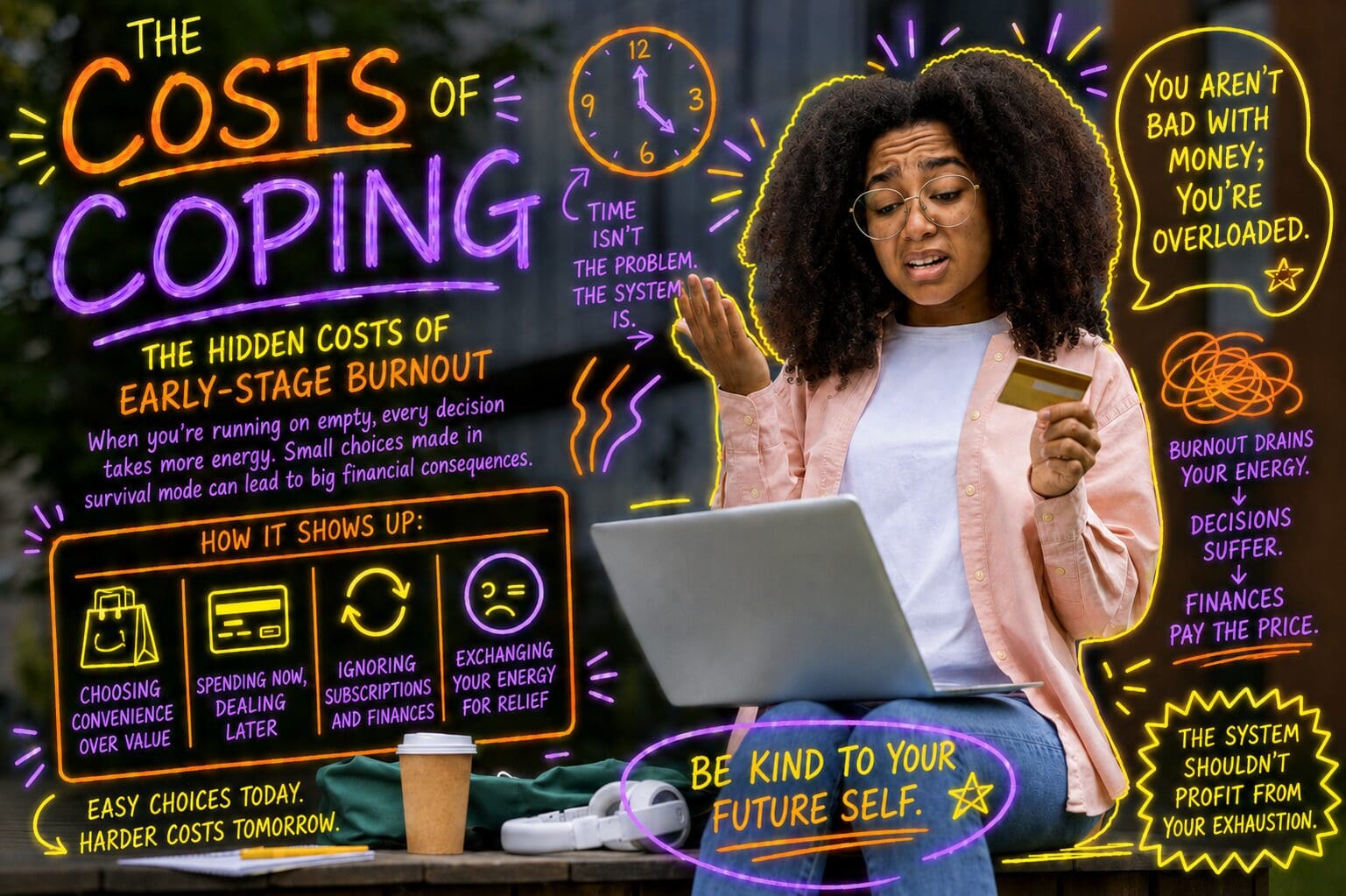
Before her autism diagnosis, Samantha spent years in corporate environments utterly baffled by her own breakdowns. She’d be fine one week. Productive. On top of things. Then the next week, or sometimes the next day, she’d be completely unable to cope.
“I remember working in this big open-plan office,” she says. “I was constantly having these meltdowns and I didn’t understand why. Now I know I was completely overstimulated. The sensory overwhelm was wild for me. But at the time, I just thought there was something fundamentally broken about me.”
The office sent her home multiple times. Not because they were concerned for her wellbeing. Because she was disrupting productivity.
Here’s what was actually happening: Samantha’s brain was already struggling with the sensory assault of an open-plan office. The fluorescent lights. The constant noise. The unpredictable interruptions. The social performance required to navigate office politics.
Then add the hormonal shifts of a menstrual cycle. The week before her period, when executive function tanks and sensory sensitivity spikes? Absolutely unbearable.
“Two people might be exhausted from the same day,” Samantha explains, “but only one of them might go home and have a complete meltdown and can’t get out of bed the next day. When you’re enforcing a very linear style of working, you’re not accounting for neurodivergence, chronic conditions, menstrual health, any of it. You’re just saying: perform consistently or fail.”
And women, trained to be accommodating and resilient, will mask until they physically can’t anymore. Then they’ll blame themselves for not being strong enough.
You’d think the wellness industry would offer an escape. You’d be wrong.
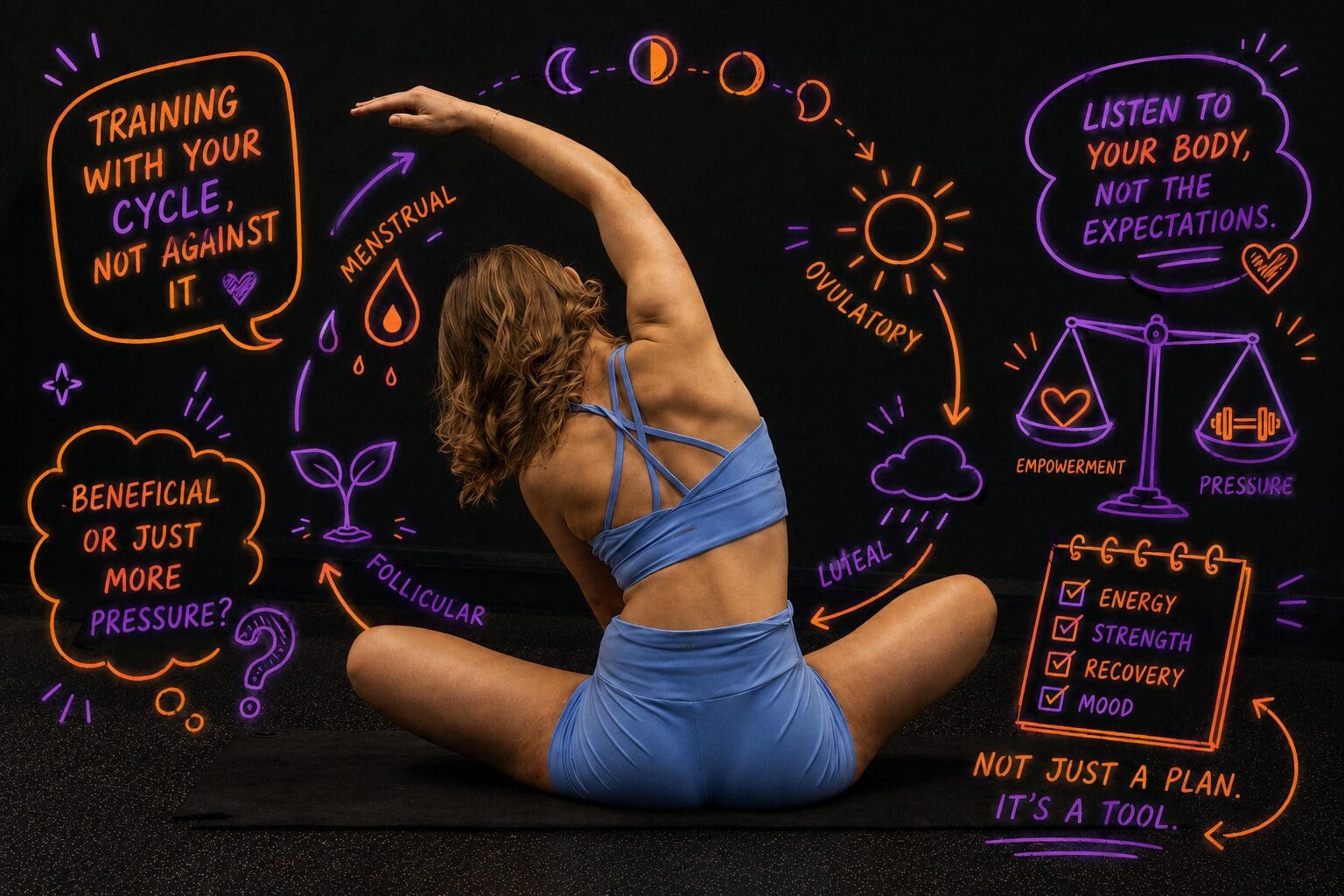
Samantha watched as cycle-syncing, originally a radical feminist practice about reclaiming your body, got co-opted by productivity culture and turned into another metric to optimise.
“It’s infuriating,” she says. “Cycle awareness started as a way for women to reclaim their bodies. Then the wellness industry grabbed it and turned it into a productivity hack. Now the narrative is: ‘Optimise your ovulatory phase so you can smash your goals!’ You’ve turned your own biology into a performance metric. If you’re tracking your cycle just to figure out which days you can push yourself hardest, you aren’t liberated. You’re just a better-oiled machine for capitalism.”
And the biohacking movement? Even worse for neurodivergent women.
“The capacity to do the same thing in the same way every single day is achievable for some people,” Samantha says. “But for someone with fluctuating hormones, it’s detrimental to their health. Add neurodivergence into the mix, and you’re asking for day-to-day fluctuation on top of weekly fluctuation. When you enforce a linear habit pattern, wake up at 5 AM, cold shower, intermittent fasting, whatever the finance bros are selling this week, you don’t account for people who need down days to recover from hyperfocus weeks.”
The wellness industry sells control. But female biology is cyclical, and neurodivergent brains are non-linear. You cannot buy your way out of that with a fucking £60 green juice.
“The antidote to wellness burnout,” Samantha says, “is lowering the bar. You don’t need a perfectly curated ten-step luteal phase routine. Sometimes honouring your cycle just means eating pasta in bed and refusing to apologise for it.”
Here’s where Samantha gets practical. Because rage is useful, but solutions are better.
She talks about inclusion passports. Not accommodations. Not adjustments. Universal workplace design.
“I like to describe them as Pokémon cards for people,” she says, and she’s not joking. “You have a sheet that says who you are, what you struggle with, and what you need to do your best work. Chronic conditions, menstrual health, neurodivergence, whatever. It sits in your employee file. When a manager comes in, they already know the capabilities, strengths, and challenges of their team. You can actually work together instead of pretending everyone functions the same way.”
It sounds simple. It’s revolutionary.
Because the current system operates on the assumption that everyone should work identically. Accommodations are framed as special treatment, something you have to fight for and justify. Universal design says: what if we just built workplaces for actual humans from the start?
“Think about biodiversity as a metaphor for neurodiversity,” Samantha says. “Biodiversity includes everything in the natural world. There are differences that allow other parts of nature to thrive. It’s the same with human brains. We need to account for those differences, not deficits, differences, to benefit from the full spectrum of what human capacity has to offer.”
She lists other changes that cost nothing: letting people wear noise-cancelling headphones in open-plan offices. Allowing email-only communication for people who struggle with phone calls. Using meeting rooms for private conversations. Not weaponising productivity metrics.
And the big one: ditching the obsession with ‘high performance’ and ‘resilience’.
“A client told me their workplace buzzword is ‘high performance,'” Samantha says. “That’s toxic. Resilience in the workplace is toxic positivity. You’re basically saying: here’s how to manage and adapt to a system that’s designed to fail you. That’s not support. That’s gaslighting.”
Samantha is cautiously optimistic about younger generations entering the workforce. Recent research from the World Economic Forum shows that 49% of Gen Z workers have taken a more flexible but lower-paid role over a rigid, higher-paid one, with 59% saying they’d forgo a higher salary for greater control over their working hours. That matters.
“I think until younger generations take over leadership roles, the pale, stale males will stay in power,” she says. “But we’re on the cusp of that changing. And it’s not just men. A lot of women have been conditioned in those toxic ways too. I get trolled by women saying ‘Get over it. Put your big girl pants on. Childbirth is worse’. They grew up in a generation that didn’t allow fluctuating capacity, that didn’t allow you to be in pain or discomfort and have that be okay.”
But the shift is happening. Slowly. Painfully. With significant pushback from people invested in the old way of working.
“I’m worried about the push to get people back into offices,” Samantha says. “That will work for some people. But for me, as an autistic person? I’d be having panic attacks. Open-plan offices were never the place of dreams for me. Now I understand why I felt like I was set up to fail.”
If Samantha could give one message to every neurodivergent woman currently beating herself up because she can’t keep up with the neurotypical men in her office, it’s this:
“Your body and brain are not the problem.”
She says it with the certainty of someone who spent years believing the opposite.
“The world is trying to catch up with understanding what we need. There are so many people working to dismantle the shame and taboos around menstruation and neurodivergence. We’ll get there. But you need to hold on to the fact that your body and brain are really not the problem. You’re just being asked to smush yourself into a really outdated culture that doesn’t make space for you yet.”
And then the kicker: “It doesn’t mean you should break yourself to fit. When we shrink ourselves to fit outdated systems, we’re just replaying what’s been. We need to stop doing that.”
Samantha’s platform keeps growing. The Period Princess keeps posting. The workshops keep happening. The conversations about universal workplace design keep inching forward.
But the fundamental tension remains: a shitty corporate culture built for one type of human (male, neurotypical, linear, consistent) trying to accommodate everyone else without actually redesigning the blueprint.
“Accommodations were a middle ground,” Samantha says. “We’re past that now. We need universal workplace design where accommodations are already baked into the culture you’re creating. You shouldn’t need to fight for the right to wear headphones or work flexible hours or take a sick day when you’re bleeding heavily. That should just be… normal.”
It’s not exactly radical to suggest that workplaces should be designed for the humans who work in them. It’s just honest.
And for the neurodivergent women navigating both a 28-day hormonal cycle and a brain that doesn’t operate on a 24-hour testosterone rhythm, Samantha’s work isn’t just advocacy. It’s survival.
“Female biology is cyclical,” she says. “Neurodivergent brains are non-linear. The most rebellious thing you can do right now isn’t buying another wellness product. It’s fiercely protecting your right to be a slow, cyclical, unpredictable human being in a world that desperately wants you to be a machine.”
She’s done pretending to be a machine. And she’s done watching other women break themselves trying.