
Some days, you hit 3 PM and you’re still firing. Other days, you hit 3 PM and your brain has left the building. You’ve done the coffees, the walks, the deep breaths. Nothing works. Meanwhile, Dave from HR sails past your desk looking irritatingly fresh after his lunchtime 5k, ready to smash through his afternoon targets like some kind of productivity machine.
Here’s what Dave won’t tell you: it’s not about discipline. It’s about biology. And the game was rigged in his favour from the start.
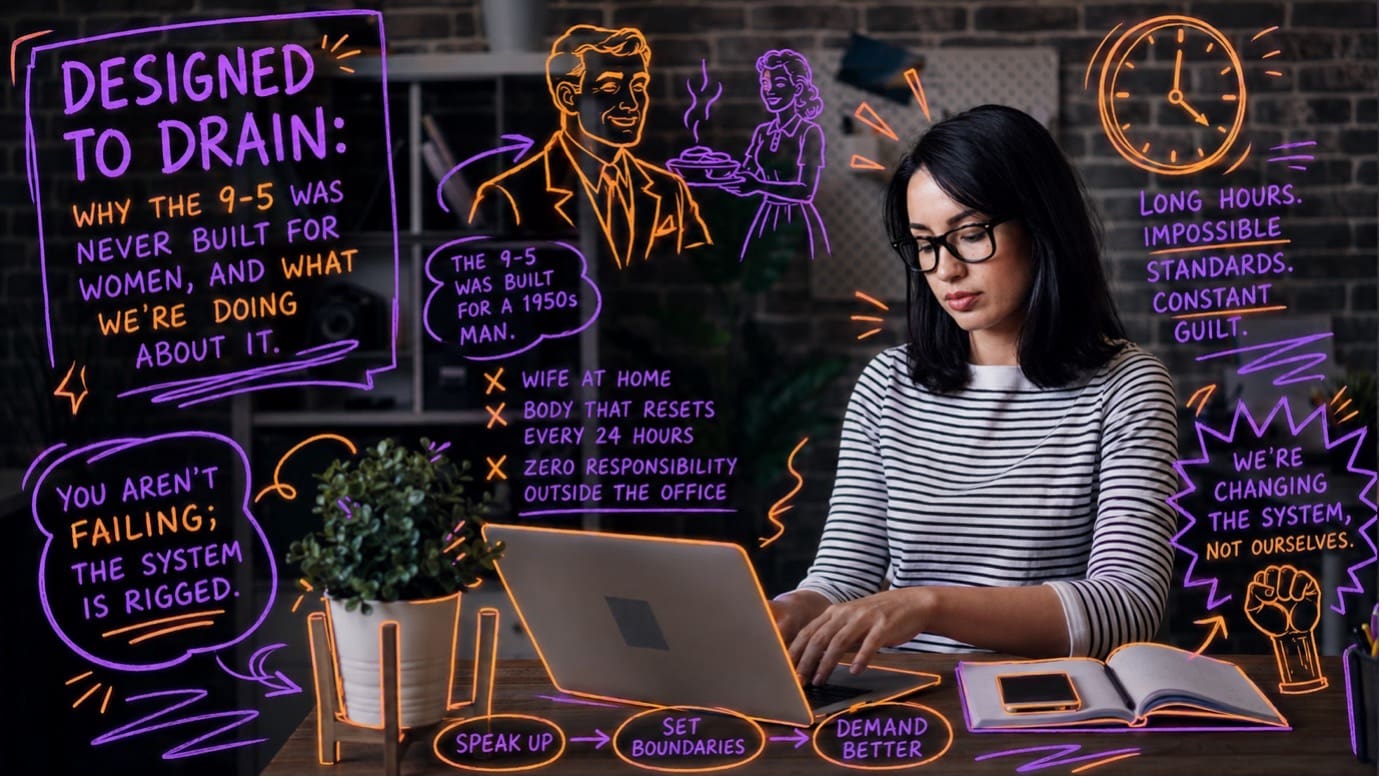
The traditional 9-to-5 was built around a male body that resets every 24 hours. Testosterone peaks at dawn, perfect timing for those early strategy meetings. Energy depletes steadily throughout the day. Sleep wipes the slate clean overnight. It’s a tidy little hormonal loop the corporate world has been worshipping since the 1950s.
Women? We’re running entirely different software. Our hormones fluctuate across a monthly cycle, not a daily one. Our energy ebbs and flows in waves the 9-to-5 was never designed to accommodate. We’re also statistically more likely to be managing households, raising kids, or caring for elderly parents on top of full-time jobs. And our brains process workplace stress differently.
But sure, let’s all just keep pretending we’re built exactly like Dave and wondering why we’re so fucking exhausted.
We fought hard to earn our place in the workforce. The problem? The male-dominated workforce never bothered to adapt to us. We got handed a rigid corporate clock, told to lean in harder, and expected to perform like machines.
“The issue isn’t that women can’t operate within a 24-hour system,” says Carla Cressy, OBE and Founder and Chief Executive of The Endometriosis Foundation.
“It’s that the system assumes consistency as the baseline. For many women, energy and cognitive clarity fluctuate naturally. When the system rewards visible endurance rather than sustainable performance, it quietly disadvantages biology that doesn’t operate in a straight line.”
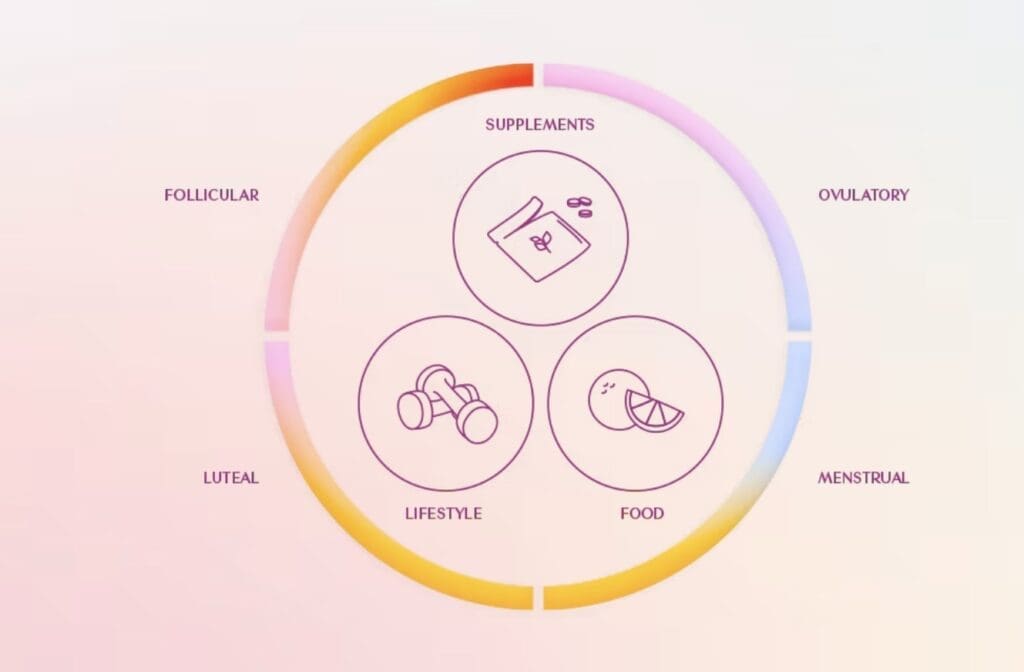
Over a month, our oestrogen and progesterone levels rise and fall, altering cognitive function, cortisol levels, and metabolic rate week by week.
One week, you’re sharp, fast, unstoppable. Next, your brain feels like it’s wading through treacle, and simple tasks take twice as long. This is not a personal failing. It’s just how female hormones work.

But the 9-to-5 doesn’t give a shit. It demands the same output, the same energy, the same brain power every single day. And when we can’t deliver robotic consistency, we’re quietly labelled unreliable.
According to a 2023 CIPD survey of over 2,000 UK women, 53% have taken time off work due to menstrual symptoms. Nearly half, 49%, lied to their managers about the real reason, citing fear of embarrassment or being perceived as weak.
Half of women would rather invent a fake illness than admit their period is making work unmanageable. That’s fucked up.
“Masking is incredibly draining,” Cressy says. “It means worrying that asking to work from home will damage your reputation. Over time, that creates anxiety and self-doubt. You internalise the idea that you’re ‘too much,’ when actually you’re just managing a biological reality the workplace refuses to acknowledge. The emotional load of constantly performing ‘fine’ can be as exhausting as the physical symptoms.”
And here’s the bullshit: even women without specific health conditions are doing this. We’re masking the exhaustion of managing school runs and household mental loads on top of our jobs. We’re masking stress responses that hit us harder. We’re masking the reality that our peak productivity windows don’t always fall neatly between 9 and 5.
This isn’t just about periods. It’s about a system that was never designed with women in mind.
Women do 60% more unpaid labour than men, according to 2023 ONS data. That’s childcare, elder care, household management, and the invisible mental load of tracking everyone’s schedules whilst trying to hit work deadlines. The 9-to-5 was designed for employees with a spouse at home managing everything else. Most women don’t have that luxury.
Then there’s how our brains handle workplace pressure. A 2014 University of Pennsylvania study found that women’s brains have significantly more connections between hemispheres, meaning we’re often processing emotional and analytical information simultaneously. When you combine that with higher baseline stress responses, you’ve got a system literally fucking designed to drain us faster.
Add in circadian rhythm differences, a 2024 study in Sleep Medicine Reviews found that women’s internal body clocks run six minutes faster than men’s, creating a misalignment with external cues like light and darkness that’s five times larger in women, and you start to see the full picture.
For women with conditions like endometriosis or PCOS, this becomes genuinely unliveable. “For women dealing with chronic pain or brain fog, the expectation to show up consistently can be impossible on certain days,” Cressy says. “And yet they’re penalised for it. Passed over for promotions. Quietly managed out.”

Alisa Vitti, functional nutritionist and creator of the CYCLE SYNCING® METHOD, experienced this firsthand. No menstrual cycle from age 12 to 22, severe PCOS, depression, anxiety, hair loss, she knows exactly how the system gaslights women.
“What people don’t realise is that ignoring our cyclical biology doesn’t just cause burnout,” Vitti says. “It’s causing rapid and premature ageing of the ovaries, which has downstream effects on everything from PMS severity to fertility outcomes. When I say ‘premature,’ I mean women in their early thirties with ovarian function you’d expect in someone a decade older. The workplace model makes it actively worse.”
So, what’s the alternative? Not empty promises about ‘reimagining work’. Actual solutions that already exist and are already working.
Take Coexist, a Bristol-based social enterprise that made headlines in 2016 when it implemented a ‘period policy’. This wasn’t about women taking days off whenever they felt like it. It was about reframing the menstrual cycle as a strategic asset rather than a shameful liability.
What they actually did: Employees can flex their working hours during menstruation without penalty. Performance reviews measure output, not hours visibly logged at a desk. Line managers receive training on having open, shame-free conversations about wellbeing. The policy applies to everyone, creating a genuine culture shift rather than stigmatising accommodations.
The outcome? Productivity went up. Sick days went down. Staff retention improved. Turns out when you actually let women work with their biology instead of against it, everyone benefits.
Then there’s the UK’s four-day week pilot, which ran from 2022 to 2023 across 61 companies and over 2,900 employees. When businesses stopped obsessing over ‘time in seat’ and started measuring actual outcomes, 92% of participating companies chose to continue the four-day work week permanently. Revenue stayed stable or increased for 86%. Meanwhile, stress and burnout dropped significantly, with the steepest declines among women, particularly those with caring responsibilities.
Nothing about the work itself changed. Just the when and the how long.
Other companies are experimenting with core hours models, where meetings happen only between 10 AM and 3 PM, with employees choosing how to structure the rest of their hours. Research tracking these models has found that burnout rates drop significantly within six months, with no negative impact on deadlines.
And crucially: these aren’t ‘women’s policies’. They’re human policies. But because women have been disproportionately penalised by rigid structures, we benefit most when those structures finally shift.
Getting your workplace to implement these changes requires strategic advocacy, not asking nicely and hoping for the best.
Laura Coryton, MBE, the activist who led the campaign to scrap the UK’s tampon tax, knows how to force systemic change.
She says: “Normalising the language of menstruation was crucial to that campaign. Same principle here. You need to normalise the language of different kinds of work. Get a committee together. Use hard data. Build an actual business case. But most importantly, stop waiting for permission.”
When negotiating flexibility for yourself, Cressy recommends speaking pure corporate deliverables. “Frame it as: ‘I can deliver X and Y to the same standard, but I need flexibility on Z days each month.’ Notice what’s missing? An apology. A biology lesson. A lengthy justification. You’re stating the terms under which you can deliver your best work.”
Vitti is even more direct. “Men have zero problem saying, ‘I need to start early so I can hit the gym at lunch, it makes me sharper.’ Nobody questions that. You don’t see men explaining their testosterone patterns to justify working preferences. So why should you have to explain yours? State what you need. Period.”
If you’re advocating for organisational-level policy changes, arm yourself with data. Women shoulder 60% more unpaid labour than men. The UK four-day week pilot saw 92% of companies continue permanently, with 86% maintaining or increasing revenue. Flexible working policies demonstrably improve staff retention and reduce burnout. Frame this as a business case, not a favour.
The infrastructure is shifting whether old fashioned managers like it or not. Adapt or get left behind. Even the British Standards Institution, the people who literally regulate how everything in the UK works, published official workplace guidelines on menstruation and menopause in 2022 (BS 30416).
This isn’t fringe activism anymore. It’s the bloody standard.
The 9-to-5 is dying. Dolly Parton saw it coming in 1980: “Barely gettin’ by, it’s all takin’ and no givin’.” Forty-five years later, that rigid schedule isn’t just outdated, it’s actively harming half the workforce.
We can’t fix a systemic design flaw through individual discipline or increasingly extreme coping mechanisms. We need entirely new infrastructure. The good news? It’s already being built. Forward-thinking companies are proving it works. The data backs it up.
Some will argue this undermines women, that demanding biological accommodations gives ammunition to sexists. Bollocks. There’s nothing weak about demanding a workplace that doesn’t systematically exhaust you.
For the millions of women burning out in silence right now, this isn’t about making excuses. It’s about finally dragging a broken system into reality instead of letting it coast on a 1950s fantasy of the “ideal worker”, someone with no biology, no caring responsibilities, no life outside the office.
So take a breath. A massive, unapologetic breath.
This isn’t about begging for special treatment. It’s about demanding basic acknowledgement of reality.
Stop fighting yourself. Fight for yourself. And beat the system.