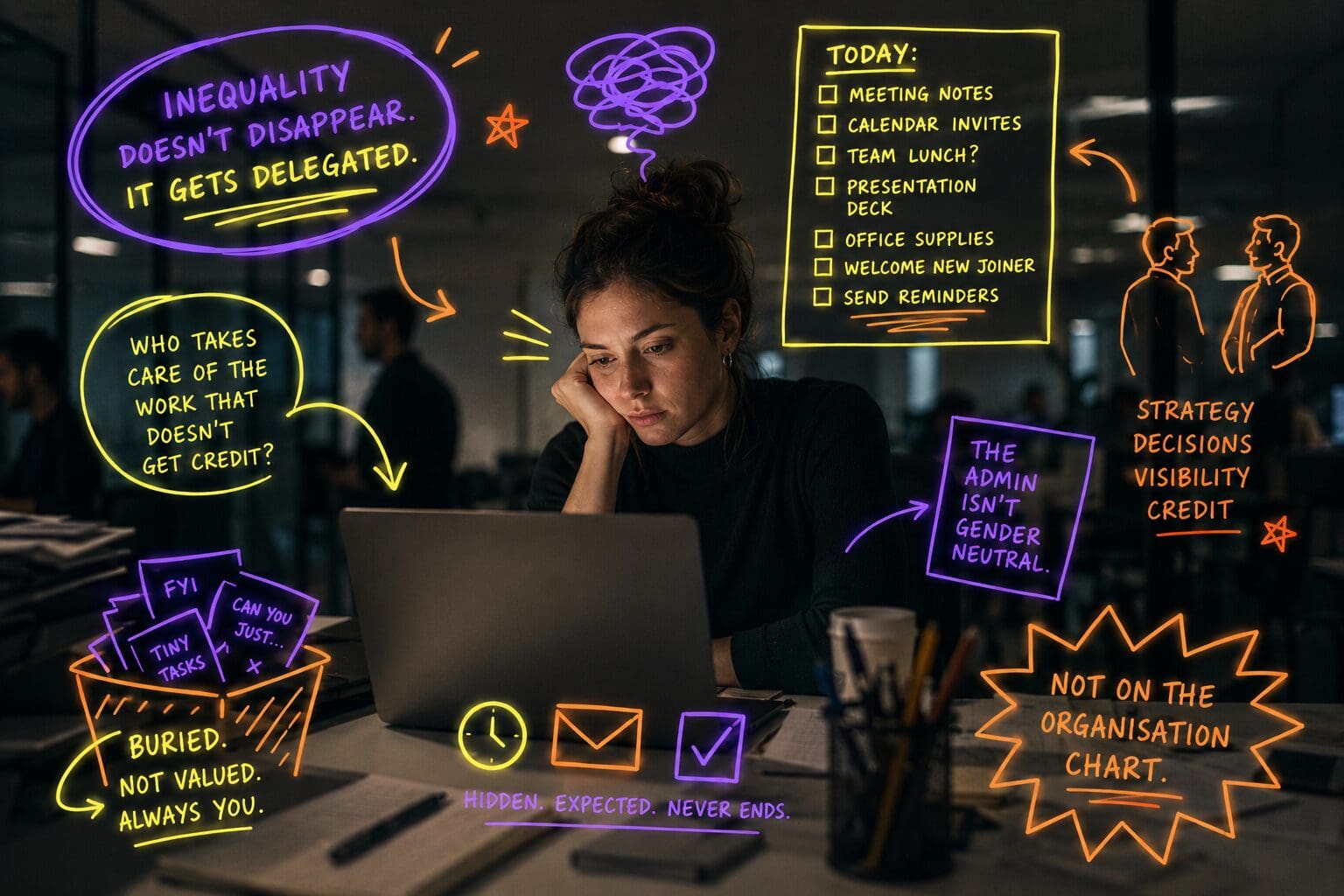

There’s a particular kind of workplace magic trick that still works in 2026, and it’s this: a group of people produce the same outcome, but one group gets rewarded, and the other group gets stuck booking the meeting room, organising the leaving card, and taking notes nobody reads.
Welcome to office housework. Not the sexy kind of work that gets you promoted or a LinkedIn humblebrag. The invisible, never-ending admin sludge that keeps organisations from collapsing into chaos – and keeps a lot of women from moving up.
And before anyone gets defensive and says, “well men do it too,” yes, they do. But the distribution is about as fair as a coin toss in a fucking rigged casino.
Tiziana Casciaro, a Professor of Organisational Behaviour at the University of Toronto, put it bluntly: “Gender roles formed over a very long historical and even evolutionary period still shape modern workplace behaviours.”
Translation: we dragged thousands of years of ‘women organise, men conquer’ baggage into the open-plan office and called it culture.
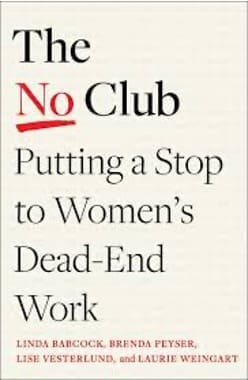
Lise Vesterlund, an economics professor at the University of Pittsburgh and co-author of award-winning book ‘The No Club’, has spent years documenting what she and her co-authors call ‘non-promotable tasks’.
“Non-promotable tasks are more administrative work, mentoring others, helping others, organising meetings, helping the new intern. Just doing the office housework,” she says. “It tends to be work that is not directly tied to the organisation’s mission and doesn’t require any specialised skills.”
Whilst these tasks aren’t specialised, they are not marginal; they keep the office running. But because they’re rarely tied to revenue or innovation, they rarely reap rewards.
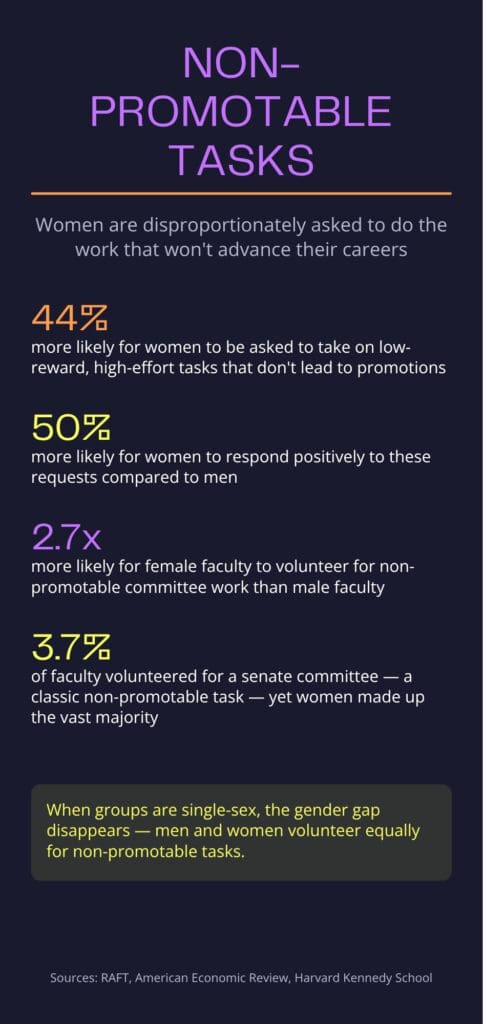
And of course, women take on these thankless tasks at a much higher rate.
“In our studies, we found that women are asked to take on these tasks abo ut 50% more than men,” says Vesterlund. “Women also say yes 50% more than men, partly due to expectations and backlash risk if they say no.”
And this gap begins early.
“These differences show up with year one of an employee working for a company, and they are very sizeable. In one workplace, women were spending 200 more hours per year on non-promotable work than their male colleagues.”
According to research in this field, women don’t just end up doing more of this non-promotable work by accident. They’re nudged into it softly with a smile.
Casciaro says: “Women end up saying yes more often because there is a strong expectation that they will be helpful, communal, and cooperative. These expectations are not written down, but they are deeply embedded in workplace culture and gender norms.”
Meanwhile, let’s not pretend men are sitting there doing absolutely nothing. That would be nonsense. Men absolutely take on some of these tasks. The difference is that when they do, it tends to get noticed, praised, and mentally filed under “leadership behaviour” rather than “someone had to do it.”
We all hear about their contributions, even when they’re relatively small. A man runs a meeting? “Strong facilitator.” A man takes notes once? “Great attention to detail.” A man organises a team lunch? Suddenly he’s the Office Culture Architect.
If a woman does all of that for a year? It’s just… Tuesday.

Here’s where it really hurts.
Vesterlund says: “Women who say no experience backlash, whereas men who say yes are going to be awarded.”
Read that again, because it’s doing a lot of work.
Say no as a woman and you risk being seen as difficult, uncooperative, not a ‘team player.’ Say yes as a man and you’re suddenly collaborative, engaged, leadership material. Same behaviour. Different scoreboard. Different consequences.
Vesterlund says: “Women are asked more frequently to take on non-promotable tasks by both male and female managers. And, once assigned more of this work early on, people tend to accumulate even more of it over time.
“If you start with more non-promotable tasks, four years later you still have more of them.”
And so the cycle repeats.
The real problem isn’t just inequality in who does the tasks. It’s what those tasks quietly do to your career trajectory while everyone pretends they’re fucking harmless.

“People with more non-promotable work are seen as lesser employees, even if they are not. This leads to lower pay, worse evaluations, and lower chances of promotion,” Vesterlund says.
That’s the brutal arithmetic of it. You become indispensable in all the wrong ways. You’re the person who keeps things running, but not the person considered when leadership conversations happen.
She says: “Non-promotable work is necessary for organisations to function, but it is undervalued because it is easily replaceable. If someone doesn’t do it, another person usually will – so it is not recognised as scarce or specialised.
“Organisations prioritise specialised, high-skill work because that is what drives external value and revenue. Administrative and coordination tasks are essential, but they do not translate into external job market value.”
Then comes the long-term fallout.
Vesterlund says: “This contributes to burnout, isolation, and career derailment. It’s exhausting to have to take on all these extra tasks and still make up all the hours you need to achieve promotion.”
Burnout here isn’t just tiredness. It’s the slow erosion of ambition. It’s realising you’re working harder but being seen less. It’s staying late after organising everyone else’s success while your own progression quietly stalls in the background like a buffering video that never loads.
And, as Vesterlund puts it, “it’s exhausting”.
The uncomfortable truth is that workplaces don’t just reward output, they reward perception. And perception is heavily filtered through gender expectations that everyone claims to have outgrown but absolutely haven’t.
Casciaro says the only way to break the cycle is with hard-core systemic change.
“Gender inequality in task allocation is reinforced by broader societal expectations that begin outside the workplace,” she says. “These workplace patterns mirror what happens in households, where women still do more unpaid care work.
“Transparency is critical.”
And before anyone groans at the word “transparency,” she’s not talking about another quarterly report nobody bloody reads.
“Organisations need to track and publicly report how non-promotable work is distributed. Making the data visible changes behaviour, because it becomes harder to ignore unequal distribution,” she says.
In other words: once people can see the imbalance, they can’t pretend it’s just “natural” anymore. You can’t unsee a pattern once it’s staring you in the face like a bad haircut in a mirror.
And yes, it makes people uncomfortable. Good. That’s kind of the fucking point.
But it isn’t just the office that needs a rejig.
Casciaro says: “Policy-level changes, such as non-transferable parental leave, are needed to shift gender roles at their root. If caregiving roles are shared at home, workplace expectations will also begin to shift over time. Without structural change, gender roles continually reassert themselves in both work and home life.
“The accumulation of small, daily tasks across home and work environments is what drives burnout,” she says. “Burnout is not caused by one factor, but by the constant layering of demands across every part of life.”
If you’re feeling like the office housekeeper and the idea of restructuring gender norms feels like a task a bit too time-consuming right now, don’t worry! There are things you can do on an individual level to lighten the load.
Casciaro says: “You have an opportunity to use that moment when you’re taking notes in the meeting, to learn something about what these people are doing. And to demonstrate that you understand the nature of the interaction.
“So, use that unpromotable task as a platform to demonstrate your skill, to learn new things, and make new connections. You are transforming what could be a test that relegates you, into something that enhances you.”
Basically, flip the narrative. See these as opportunities to grow, not opportunities to be passed by.
Office housework isn’t about who is “nice” or “mean,” or who volunteers more often. It’s about how deeply embedded expectations quietly shape who gets rewarded and who gets relied on.
Women are not naturally better at organising calendars, smoothing social tension, or remembering birthdays. They’ve just been socially assigned those roles so consistently that the assignment starts to look like nature.
And unless organisations start measuring what they’ve been ignoring, the system will keep doing what it’s always done: rewarding visibility, praising the wrong things, and calling it fairness while half the workforce quietly burns out keeping everything afloat.
Or to put it less politely: the office runs on unpaid emotional and administrative labour and pretending it’s just ‘being helpful’ is bullshit.