
When I was 19, I was working in hospitality, studying for a university degree, sleeping badly and running almost entirely on adrenaline.
At the time, I thought I was on top of the world. What I didn’t realise was that I was becoming manic.
The episode led to a bipolar diagnosis, making me one of 500,000 women living with bipolar disorder in the UK.
Looking back, one of the reasons it took so long to recognise was because so many of the warning signs looked suspiciously similar to the things young workers are actively rewarded for.
At the time, it didn’t feel dangerous.
It felt impressive.
People complimented how much I could get done. I was saying yes to every shift, every plan, every opportunity. I wasn’t sleeping much, but I wasn’t tired either.
Why would I have thought something was wrong?
As psychiatrist and Chief Wellness Officer for the University of Tennessee System, Dr Jessi Gold, says: “We often reward and praise people for productivity without necessarily looking at what might be driving it.
“If you’re inching towards mania, you might actually be very productive. You might hyperfocus and get seventeen projects done in one day. Someone is going to tell you, ‘Good job.’ We often get praised for overwork, and mania can sometimes look like that.”

The workplace champions the symptoms of bipolar disorder, until the same behaviours that were celebrated suddenly become concerning.
Years after my diagnosis, I found myself in a familiar cycle. Taking on too much. Working through lunch. Staying late. Convincing myself I was coping because I was still getting everything done.
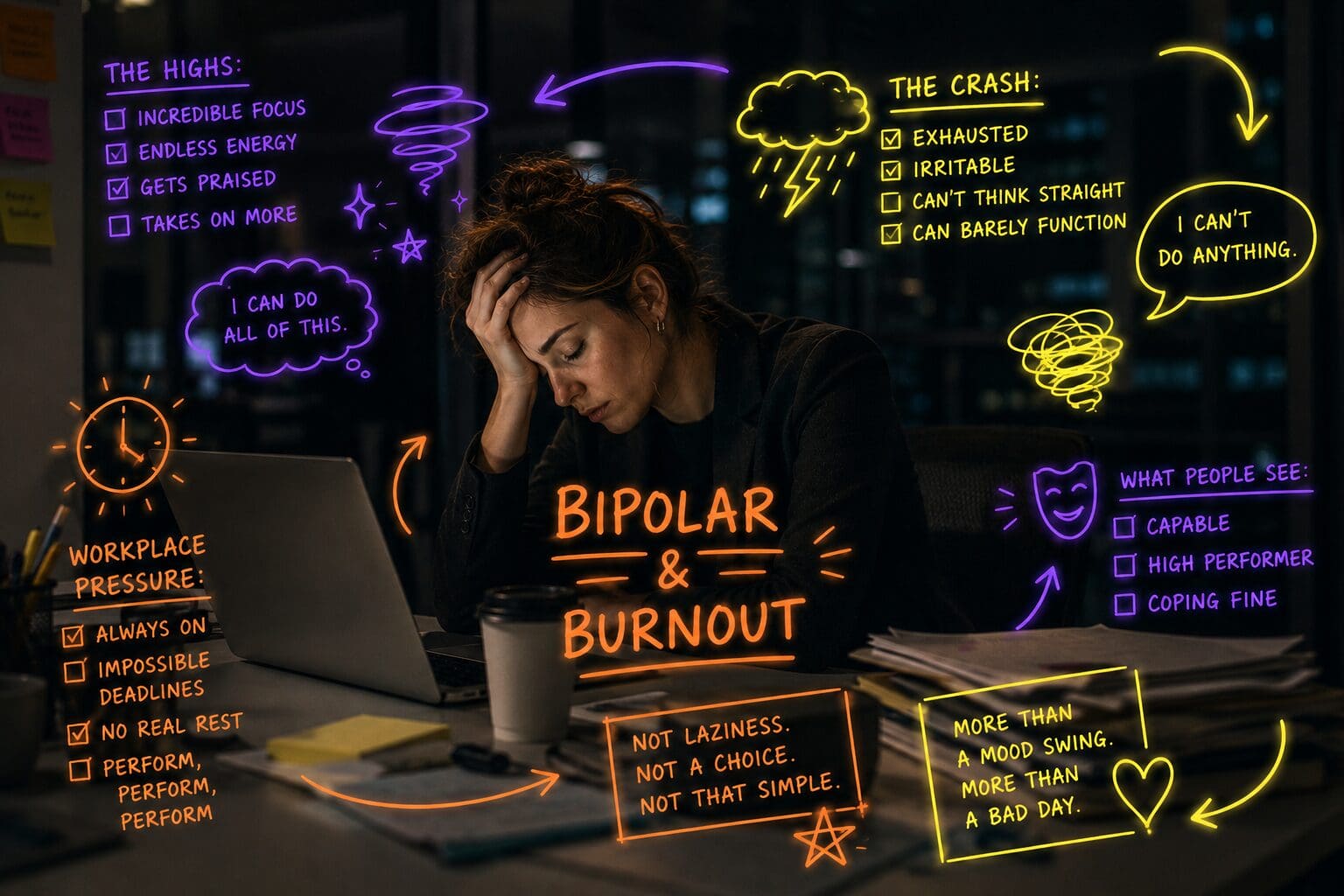
The problem is that burnout and bipolar disorder can sometimes wear the same outfit.
Exhaustion. Difficulty concentrating. Feeling overwhelmed. Struggling to switch off.
For women with bipolar disorder, figuring out whether you’re experiencing workplace burnout or the early signs of an episode isn’t always fucking easy.
There have been times where I’ve stared at my laptop wondering whether I needed a holiday, a medication review or just a decent night’s sleep.
The symptoms blur together until you’re left trying to work out whether you’re overwhelmed by your job or losing control of your mood.
“I always tell my patients that have bipolar to track their sleep, no matter what,” says Dr. Gold.
“Sleep is one of the most important warning signs.”
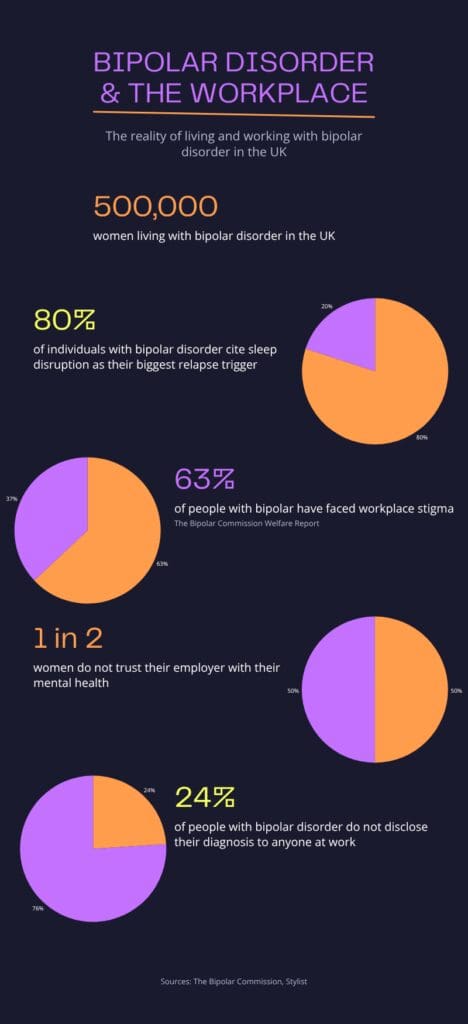
A lack of sleep is often one of the earliest indicators that something is shifting. A study conducted by Bipolar Uk found that 80% of individuals with bipolar disorder cite sleep disruption as their biggest relapse trigger.
That can make modern workplaces particularly difficult to navigate.
“I see a lot of people that do shift work, which is particularly challenging for somebody whose mood is very affected by how much sleep they get,” Dr. Gold says.
“It could be the difference between them becoming depressed or becoming manic because they are not sleeping as part of their job.”
But while burnout and bipolar disorder can overlap, there are important differences to help you tell the difference between your mental health condition and burnout.
“Burnout is a workplace-associated condition, meaning it comes from work. You might feel tremendously better on a weekend or on vacation because you’re away from the stressor. Whereas with bipolar disorder, it’s your brain,” Dr. Gold says.
“You’re not going to magically feel better because you’re on vacation or because it’s Sunday. In burnout, if you feel uninterested, it’s usually because you don’t have capacity, not because you’re sad.”
I know that I’ve taken annual leave before expecting to come back refreshed, only to realise that changing my environment hadn’t changed what was happening in my head.
Everyone talks about burnout as though the solution is obvious: take a break, switch off, book a holiday.
But there’s a particular kind of loneliness that comes with realising your problem isn’t staying behind at the office: you pack it into your suitcase and take it with you.
For me, work wasn’t always the problem, but not feeling supported at work was.
The Bipolar Commission Welfare Report found that up to 63 per cent of people with bipolar have faced workplace stigma, and part of the challenge is that bipolar disorder often doesn’t look the way people expect it to.
“A large majority of people are just working and showing up every day and also happen to have bipolar disorder,” Dr. Gold says. “They have symptoms that are very under control and you would not know they were sick.
“You would just assume that your colleague was exactly the same as you, with nothing behind that that is a struggle or a challenge.”
That stigma creates another layer of exhaustion. Not just managing symptoms, but managing other people’s perceptions of them.
“People see all these extreme cases of bipolar that are in the media, then you go, ‘Oh, is that what that looks like?’ because of that it makes it even more of a thing that people hide,” Dr. Gold says.
“It’s harder for people to say that they have it. I think it’s harder for it to feel normal, and I think it’s harder to feel understood with it. People understand anxiety and depression in the workplace much more than they understand bipolar disorder.”
The result is that many women end up navigating bipolar disorder at work quietly.
Not because they’re unable to do their jobs, but because they’re unsure how their diagnosis will be interpreted if they disclose it.
Research shows that almost one in two women do not trust their employer with their mental health, and about 24 per cent of people with bipolar disorder do not disclose their diagnosis to anyone at work.
But bipolar disorder doesn’t just go away, and you can only hide it for so long.
“What happens for so many is they tend not to notice until it really impacts their life.” Dr. Gold says.
“You forget to turn something in. You yell at your boss. You yelled at your friend. Some sort of social consequence or work consequence. You don’t tend to notice, ‘Oh, I just feel off,’ because you usually still do your job and do your job well when you feel off.”
It can be scary to navigate bipolar in the workplace, because you’re constantly juggling your illness, your wellness, and your workload whilst also navigating a world that doesn’t quite get it.
For anyone reading this after a recent diagnosis, Dr. Gold has a simple message.
“I really would encourage you to know that you can still do the things you want to do,” she says.
“Finding the right medication is not easy. It can feel frustrating and hard and imperfect, but when it works, it works.”
I wish somebody had told me that when I was diagnosed.
At 19, bipolar disorder felt like the end of something. I worried about whether I’d be able to have the career I wanted, whether employers would take me seriously, whether every success would come with an asterisk attached.
I’ve had periods of burnout. I’ve had days where my brain has made life significantly more difficult than it needed to be. I’ve had bosses and coworkers use bipolar like an adjective to describe mardy behaviour whilst I’m navigating the true consequences of the illness.
But I’ve also built a life I love.
I’ve finished my degree. I’ve hit deadlines. I’ve progressed professionally. I’ve done all the ordinary things people worry a bipolar diagnosis might stop them from doing.
And if there’s one thing I’ve learned since that first manic episode, it’s that a bipolar diagnosis doesn’t put a ceiling on your ambitions or the things you can achieve at work.
It just means learning to look after yourself while you chase them.