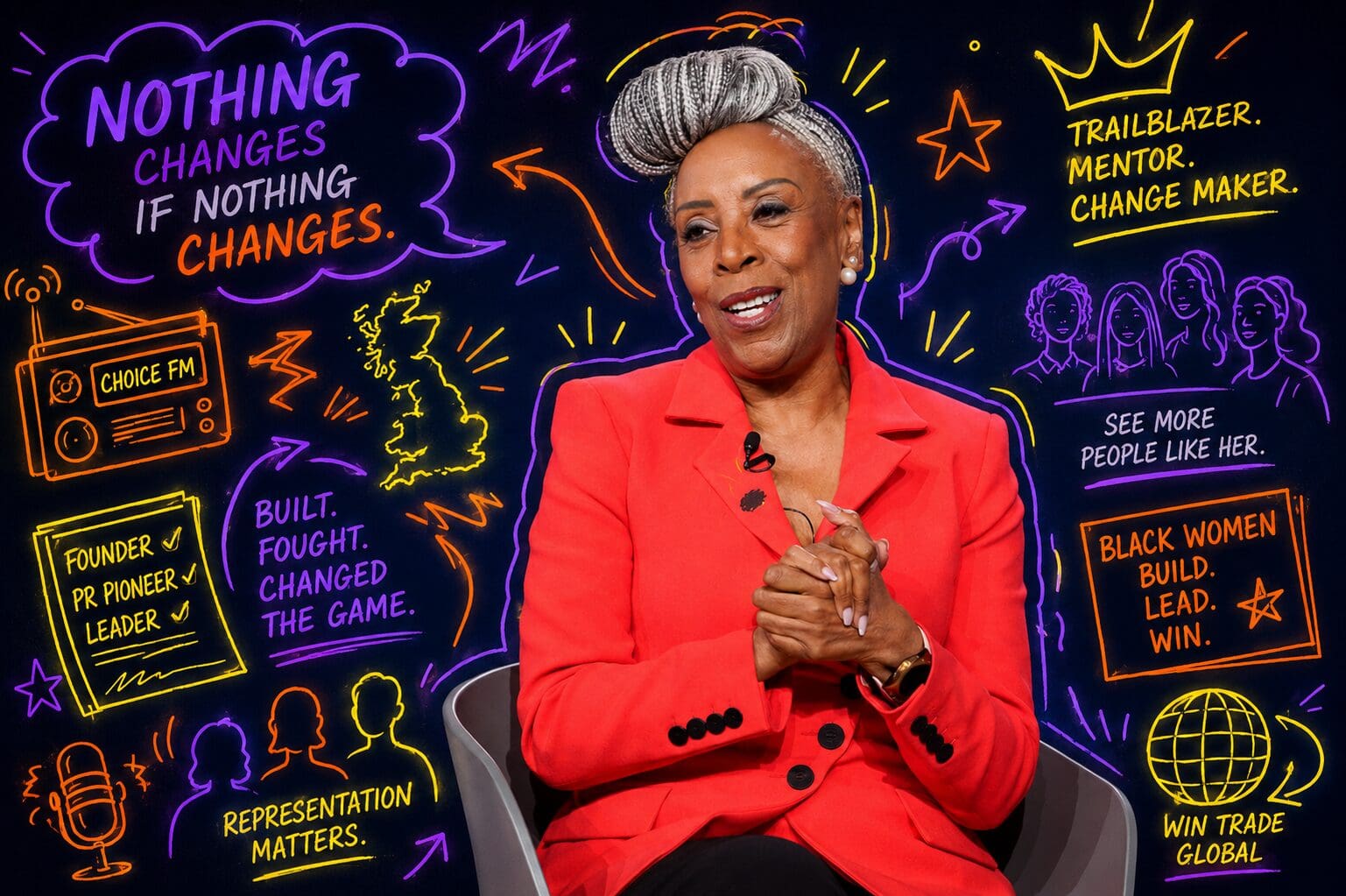

Yvonne Thompson is a British business leader and trailblazer in a range of industries that didn’t want her making it anywhere near as far as she did.
Our phrase ‘nothing changes if nothing changes’ has been embodied by Yvonne for decades, and none of her career success was simply the path of the course- she is the only female founding member of radio station Choice FM (which we know today as Capital Xtra) and went on to found her own public relations company, ASAP Communications, pioneering the provision of bespoke PR services for black music artists.
Ctrl+Shift Magazine asked Yvonne: When you started ASAP Communications, you were also a single mother by that point. How did it feel to be carrying all of that at once?
“I was three rungs down the ladder, if you like. Female, black, and single parent. But for me, I was determined not to be just another number on the unemployment list.
“Nothing comes easy. Way back then, it was still the norm to expect that if I was to go into a bank and ask for a loan, they would want it countersigned by a man. And to a certain extent, when you look at figures around funding and who gets the funding, it’s the men, then it’s the white women, then down the bottom, it’s the black women. As far as the percentages and the money goes”.
That sounds exhausting. Having to work harder than everyone else just to get to the same destination.
“At that time, you don’t stop and think. It’s only when you’ve gone through it that you stop and think, and reflect.
“But for me, as an entrepreneur then, I don’t think I had the time to stop and think, ‘Oh, that’s unfair’. You just get up and get on with it. You find your focus and focus on your focus, not about what else is going on and who’s getting what. You find your path and go down there.”
The phrase find ‘find your focus’ is one that Yvonne emphasised when explaining how she navigated her various career paths.
She has also written as music editor of Root magazine, the UK’s first black glossy magazine Root on her way to pushing black British music into the mainstream.
But before entry into the music industry, Yvonne’s first career was in the healthcare industry.
You originally trained to be a doctor, then a nurse. What changed your mind?
“It was over 45 years ago, so not only was it not usual to see women in those positions, it was even more unusual to see women of colour in those positions. There were lots of nurses, and I suppose people had to work through the system or up the system, but I still was not at that point seeing the results or seeing a pathway for me.
“I was just uninspired, if you like, because I didn’t see anyone that looked like me in those positions. So it was difficult to see how I could get there.”
You went into the music industry instead, at CBS Records, where you stayed nearly eight years. You were passed over for promotion repeatedly. What was the moment you decided to leave?
“I stood in certain positions when either people were on holiday or when there was a vacancy there. Then I’d apply for those same roles when they were advertised properly, and they’d go to someone else. I realised it was never going to happen.
“So I realised at that point the only way for me to move up was to move out.”
A few years into running ASAP, you were invited to be one of the founders of Choice FM, the UK’s first Black music radio station. Knowing how difficult was it to push black music into the mainstream, what were some of the biggest difficulties along the way?
“It was frustrating at times, because I was the only woman on a minority-owned radio station. There were nine men and me. So I always say, I feel like a minority within a minority.
“And then it came to the point where it was time to cough up to buy your shares, and the kind of money we needed for the full shares offered, I wasn’t in a position to do that. So apart from doing PR, I became the best saleswoman that I ever knew. I asked my parents to loan me the money, by remortgaging their house. They believed in me that much.
“A couple of mainstream sales houses were also instructed not to sell to Choice FM, or not to sell Choice FM to some of the biggest sponsors. Our community was not enough to sustain us on its own. In order to let it grow, we had to let it go.”
Choice FM eventually sold to Capital Radio Group in 2003 and is now Capital Xtra. There’s a version of that story where the sale feels like a loss. Does it?
“The music has changed and the DJs have changed, but if it wasn’t for us, it probably wouldn’t have been there now.
‘’It’s a bit like trying to stop the tide- it was going to happen whether we were there or not. So at least it’s still a legacy that we started. That will never change.”
In 1996, you founded what became the European Federation of Black Women Business Owners, now Win Trade Global. What was the inspiration?
“A delegation of Black businesswomen came over from the States. They were part of an organisation called the European Federation of Black Women Business Owners, and they were surprised to see that London was so diverse, and even more surprised to know there were actually women of colour who owned their own businesses.
“Their president invited me to one of their events in Washington. It was the first time I’d ever walked into such a huge room because everything in America is much bigger than everything here anyway. The Hyatt in Washington, and it was all Black women. And they were all powerful Black women that owned their own businesses. And I thought, this is something that has to be happening in London. That was my inspiration.”
You’ve talked before about your mum and your sisters being your “real models, not role models.” What did you mean by that?
“I come from a history of strong women. My mum was a strong woman. I’ve got two elder sisters who were real role models. I call them real models, not role models, because they weren’t playing a role. They were the real models for me, and they inspired me to go forward and do what I wanted to do.”
You’ve spent your career both founding your own things and working inside institutions, government committees, the Parker Review, university courts, more recently working with the royal household as a Deputy Lieutenant. Which is harder, building outside the system or fighting from inside it?
“I used to think being an entrepreneur was much harder, having to set your own goals, deliver your own deliverables, find your own money, find your own audience. At one point I thought that was much tougher.
“But more recently, more so since COVID, I’ve really begun to understand the battles you have internally within a corporate structure. You get to a certain point within an organisation and then you can go no further. That’s for women and minorities. So if you’re working for yourself, yes, you’re responsible for everything. But at least you get to choose your own clients.”
For a reader who’s at the start of her career, weighing all of this up, what would you say about passion as a career compass?
“For me, it’s about being passionate about what you do. My passion keeps me up late at night, wakes me up early in the morning, and sleep gets in the way.
“But alongside that passion, you have to remember, your passion is not always going to pay. So you have to find the middle ground. Sometimes it doesn’t pay. Sometimes it takes a long time to pay. But you have to keep in mind why you’re doing it.”
Last question. If you could say one thing to your younger self, the woman who walked out of CBS Records, who remortgaged her parents’ house to be in the room at Choice FM, what would it be?
“I would say, thank you. You did a great job.
“You will get disheartened. You will want to give up. And you will ask yourself, was it all worth it? I would say, yes. It was all worth it. Because you will get to a point where you can look back and say thank you to your younger self.”